One of my customers is hiring for the Scrum Master Role and asked if I had a handy-dandy Scrum Master Job Spec that they could use. I did not, but there have been a few good ones floating around in the ether so I thought that pulling one together would be a good idea anyway. Here is my best effort to use the existing job postings, and combine them with the latest version of the Scrum Guide.
Hiring a Professional Scrum Master
The Scrum Master is a challenging position to hire for and finding the right person is even more difficult. Ultimately the Scrum Master is accountable for the effectiveness of the Scrum Team. That means that they need to have some level of knowledge of both the relevant business domain to help the Product Owner, as well as enough technical knowledge to help the Scrum Team.
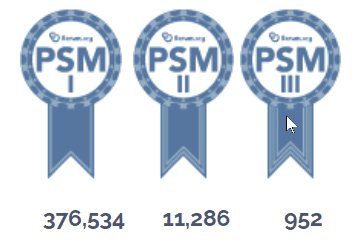
While there is no need for a Scrum Master to be technical, they do need to understand what effective looks like within the product and the technical domain within which you are creating the product. Ultimately it’s worth remembering that certification is not an indication of competence, but may be used as a simple bar to reduce the load on interviews and assert a minimum level of knowledge. At $200 for a PSM I assessment and $250 for the PSM II assessment, and with a reputation in the industry of not being totally easy, these are a no-brainer for any aspiring or experienced Scrum Master. At the time of writing there are more than 350k people with PSM I and 11k people with PSM II .
A Scrum Master Job Spec
The Scrum Master is accountable for establishing Scrum as defined in the Scrum Guide. They do this by helping everyone understand Scrum theory and practice, both within the Scrum Team and the organization. The Scrum Master is accountable for the Scrum Team’s effectiveness. They do this by enabling the Scrum Team to improve its practices, within the Scrum framework. Scrum Masters are true leaders who serve the Scrum Team and the larger organization.
Role Summary
This Scrum Master position is a leadership role that is accountable for the effectiveness of the Scrum Team by:
-
Leading, training, and coaching the organization in its Scrum adoption;
-
Helping establish empirical product planning for a complex environment;
-
Helping find techniques for effective Product Goal definition and Product Backlog management;
-
Coaching the team members in self-management and cross-functionality;
-
Helping the Scrum Team focus on creating high-value Increments that meet the Definition of Done;
-
Causing the removal of impediments to the Scrum Team’s progress;
-
Ensuring that all Scrum events take place and are positive, productive, and kept within the timebox.
-
Planning and advising Scrum implementations within the organization;
-
Helping employees and stakeholders understand and enact an empirical approach for complex work;
-
Removing barriers between stakeholders and Scrum Teams.
Should work to build a trusting and safe environment where problems can be raised without fear of blame, retribution, or being judged, with an emphasis of healing and problem-solving.
Role Requirements
The successful candidate must have the following attributes:
-
First level Scrum Master certification (PSM I, CSM, RSM)
-
Excellent Leadership skills; with a proven track record of assessing the Scrum Maturity of the team and organization and coaching the team to higher levels of maturity, at a pace that is sustainable and comfortable for the team and organization
-
Personify Scrum and Agile; Providing all support to the team using a servant leadership style and leading by example.
-
Facilitation skills; Facilitating getting the work done without coercion, assigning, or dictating the work; Facilitating discussion, decision making, and conflict resolution
-
Excellent communication skills; Assisting with internal and external communication, improving transparency, and radiating information
-
Diverse knowledge of agile mindsets; an ability to guide and coach the Scrum Team in self-management to fill the intentional gaps of the Agile/Scrum frameworks.
In addition, the successful candidate will have some or all of the following attributes:
-
Second level Scrum Master certification (PSM II, CSP)
-
Experience playing the Scrum Master role for at least two years for a product development team that was diligently applying Scrum principles, practices, and theory.
-
Knowledge of other Agile approaches: XP, Kanban, Crystal, FDD, Less, Nexus, etc
-
[If Software Team] Knowledge and/or experience with widely successful Agile techniques: User Stories, ATDD, TDD, Continuous Integration, Continuous Testing, Pairing, Automated Testing, Agile Games
-
[Applicable knowledge of the Business used by the team] <– Add your Business Domain Here
-
[Applicable knowledge of the technologies used by the team] <– Add your Technical Domain Here
Role Sucess
If the Scrum Master is successful then the Scrum Team will have the following characteristics:
-
Reliable delivery of the quality valuable product.
-
Solid understanding of Scrum framework, theory, & values
-
Continuous improvement and learning
-
Happyness
-
Self-sustaining
I would love to get your feedback and discussion on this job specification so that we can make it better!
Sources:
- Scrum Guide | Scrum Guides
- Scrum Master job description | Scrum.org
- Scrum Master job description - The Ultimate Description (luis-goncalves.com)
Smart Classifications
Each classification [Concepts, Categories, & Tags] was assigned using AI-powered semantic analysis and scored across relevance, depth, and alignment. Final decisions? Still human. Always traceable. Hover to see how it applies.
What to read next
There Is No Such Thing as a "Junior" Scrum Master
Argues that the Scrum Master role requires proven mastery and real-world experience, not entry-level skills or certifications, and should be …
Why Most Scrum Masters Are Failing and What They Should Know
Many Scrum Masters lack core Scrum knowledge and technical skills, leading to poor team support. Learn key competencies needed for …
Hiring a Professional Product Owner
Explains the key accountabilities, skills, and behaviours required for a Scrum Product Owner, including hiring trends, role requirements, …
Great Scrum Masters Need Technical, Business, and Organisational Mastery
Scrum Masters are most effective when they combine leadership skills with technical, business, and organisational mastery to support teams, …
The Competence Crisis in Scrum Master Roles: A Call for Excellence
Many Scrum Masters lack essential skills and experience, leading to poor agile outcomes. True competence requires deep knowledge, practical …
What will you learn on the professional scrum master course?
Gain practical skills and deep understanding of the scrum master role, scrum theory, empiricism, team dynamics, and delivering value in …
Detecting agile theatre with real delivery signals
Why Most Companies Operating Models Fail in Dynamic Markets
A concise comparison of Predictive and Adaptive Operating Models, explaining why traditional structures fail in dynamic markets and how …
Don’t Manage Dependencies, Remove Them
Explains why dependencies are a sign of poor system design and outlines steps to eliminate them by aligning teams, clarifying ownership, and …
The Estimation Trap: How Tracking Accuracy Undermines Trust, Flow, and Value in Software Delivery
Tracking estimation accuracy in software delivery leads to mistrust, fear, and distorted behaviours. Focus on customer value, flow, and …
Flow of Value vs Flow of Work – Misnomer or Useful Shorthand?
Compares “flow of value” and “flow of work” in Kanban, explaining why only validated outcomes count as value and stressing the need for …
Why Outsourcing DevOps Fails, and How Real Engineering Excellence Starts With Your Team
Avoid DevOps vendor lock-in, discover how true engineering excellence starts with partnership, not outsourcing. Ready to transform your …
The Definition of Done is a Commitment to Quality
Defines the Definition of Done in Scrum as a clear, shared standard for quality, ensuring increments are releasable, transparent, and …
Why Your Definition of “Done” Is Holding Back Quality, Agility, and Trust, And How to Raise the Bar
Is your team’s “done” really done? Discover how a clear, objective definition of done boosts quality, agility, and trust in product …
Acceptance Criteria vs Definition of Done: Why Getting This Right Builds Trust and Delivers Quality Faster
Stop confusing acceptance criteria with definition of done, learn the crucial difference to boost quality, speed, and trust in your agile …
How to Evolve Your Definition of Done: Start Small, Grow Smarter, and Build Lasting Momentum
Unlock a smarter Definition of Done, start small, evolve standards, and build team momentum without overwhelm. Discover how progress drives …
Why Most Transformations Fail Without Honest Conversations
Most transformations fail without open, honest conversations that address real issues, making transparency and tough dialogue essential for …
Why Your Definition of Done Is the Secret Weapon for Real Business Impact and Agile Growth
Transform your definition of done into a strategic advantage, deliver real value, reduce risk, and drive business impact with every sprint.
Don’t Manage Dependencies, Remove Them
Explains why dependencies are a sign of poor system design and outlines steps to eliminate them by aligning teams, clarifying ownership, and …
Why Outsourcing DevOps Fails, and How Real Engineering Excellence Starts With Your Team
Avoid DevOps vendor lock-in, discover how true engineering excellence starts with partnership, not outsourcing. Ready to transform your …
Why Big Bang Rewrites Fail: How Sustainable Change and Engineering Excellence Transform Legacy Systems
Ditch the Big Bang rewrite. Discover why sustainable, in-place change drives true engineering excellence and lasting transformation in your …
Is Agile Really Just a Mindset?
Explores Agile as a disciplined system of delivery, emphasizing engineering excellence, CI/CD, observability, and system design over mindset …
Telling People What to Do Is Not Leadership. It’s a Failure of System Design
Explores why real leadership means designing systems that enable team autonomy, flow, and accountability, rather than relying on …
From Legacy Pain to Modern DevOps: My Proven Roadmap for Real Engineering Transformation
Transform legacy engineering with a proven, step-by-step approach, learn how to automate, adapt, and build a resilient, modern DevOps …
Why Most Companies Operating Models Fail in Dynamic Markets
A concise comparison of Predictive and Adaptive Operating Models, explaining why traditional structures fail in dynamic markets and how …
Getting Started with Objectives & Key Results
Learn how to successfully implement OKRs by aligning clear strategy, fostering transparency, empowering teams, focusing on outcomes, and …
Futureproof Leadership: How CTOs Can Cut Through the Noise and Lead with Clarity, Confidence, and Culture
Struggling with tech change? Discover how clarity, evidence, and culture can futureproof your team, no chasing trends, just smart …
From Burnout to Breakthrough: How CTOs Can Lead with Clarity, Resilience, and Real Innovation
Feeling overwhelmed as a tech leader? Discover how to shift from chaos to clarity and build resilient, future-ready teams, without burning …
Human and AI Agency in Adaptive Systems: Strategy Before Optimisation
Explores the distinct roles of human and AI agency in adaptive systems, emphasising human-led strategy and accountability versus AI-driven …
Stop Chasing Trends: How Real Agility and DevOps Build Resilient, Adaptable Teams
Stop chasing trends, build real agility. Discover how DevOps and agile create resilient teams, smoother delivery, and sustainable …