One of my customers is asking me about the accountabilities of a Product Owner and how they break down. While I had seen many things around the Scrum Master for my post on Hiring a Professional Scrum Master , this was a little bit more of a discovery session, which is why I asked some of my trusted colleagues at Scrum.org to help out.
This represents my best efforts to pull together a specification of the Product Owner accountability from the Scrum Guide, agile practitioners, and a little bit of experience.
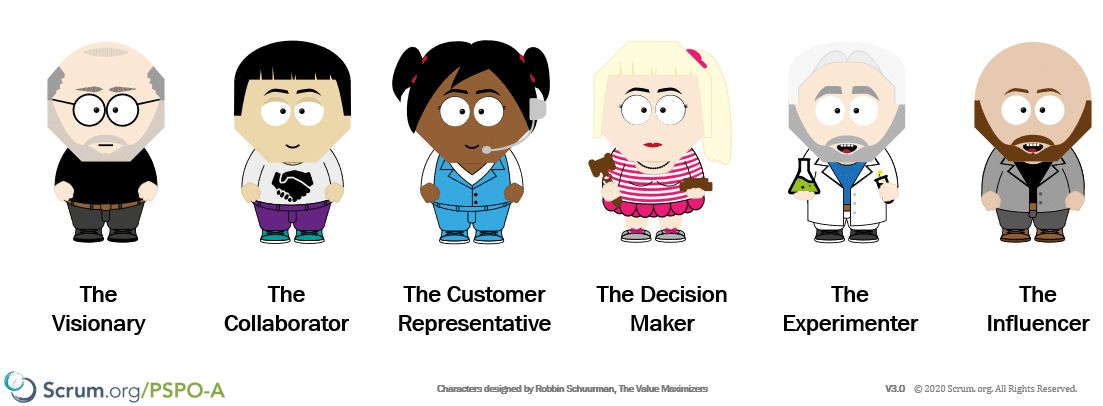
Professional Scrum Product Owner Stances
Hiring a Professional Product Owner
In general, I do not see companies hiring for a Product Owner but instead promoting from within. Maximizing the value in the product requires intimate knowledge of the business context, the existing state of the market, and the things that make your business distinctive. They need not only these understandings but also the ability to communicate effectively with Developers and Stakeholders.
My take on the above…I am seeing the opposite. I’m seeing more companies valuing Product Ownership as a skill and going outside for it. I think this is a positive trend and will probably have the benefit of bringing an outside perspective to a company which may be exactly what a product needs.
Data: LinkedIn has 12,894 jobs for “Product Owner just in the US right now and 25,520 for “Product Manager”. Didn’t look at global numbers.
Adding to Jim’s data:
| Country / Job Title | Product Owner | Product Manager |
|---|---|---|
| USA | 12,894 | 25,520 |
| UK | 9,256 | 23,241 |
| EU | 25,254 | 35,626 |
| Worldwide | 119,808 | 300,060 |
Data of Jobs posted on LinkedIn!
If you just need short litmus tests for product ownership then Jim Sammons sent me this “Five A’s of Product Ownership” graphic.
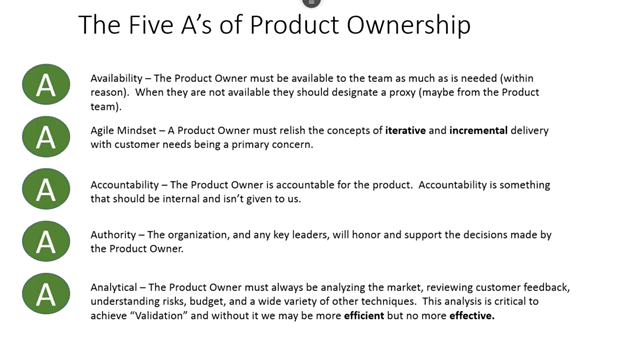
Five A’s of Product Ownership
I do mention certifications, both from Scrum.org and Scrum Alliance, and please be aware that certification is not an indication of competence but may be used as a simple bar to reduce the load on interviews and assert a minimum level of knowledge, at $200 for a PSPO I assessment and $250 PSPO II assessment. With a reputation in the industry of not being totally easy, these are a no brainer for any aspiring or experienced Product Owner. There are more than 100k people with PSPO I and 2k people with PSPO II at the time of writing.
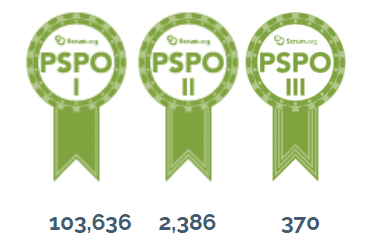
The assessments can be used to inspect and adapt your own knowledge and there is even a free Product Owner Open assessment.
A Scrum Product Owner Job Spec
The Product Owner is accountable for maximizing the value of the product resulting from the work of the Scrum Team . How this is done may vary widely across organizations, Scrum Teams, and individuals.
Role Summary (Accountabilities)
This Product Owner is a key position that sets the tone for product leadership and the definition of success in the organization. As such, modern product management practices and mindset are expected to be put into practice daily. This Product Owner is accountable for and has the authority to maximize the value of the product and the effectiveness of the Product Backlog by using, but not limited to, these 6 key stances:
-
The Visionary
- Articulating the strategic vision of the product;
- Developing and explicitly communicating intermediate strategic goals;
- Propose how the product can tactically increase its value each Sprint;
- Understand and shape the impact of the product on our company;
- Each Sprint ensuring that the Scrum Team is prepared to discuss the most important Product Backlog items;
-
The Influencer
- Actively manage stakeholders, their desires, expectations, and outcomes;
- Create an effective communication strategy;
- Influence the Developers during Backlog Items Sizing by helping them select and understand trade-offs;
- Work with Developers daily to clarify and renegotiate the Scope of the Sprint;
-
The Collaborator
- Collaborating closely with the Developers & Stakeholders daily;
- Developing and communicating budget, investments, roadmaps, vision, & strategy;
- Developing controls for a change, risk, quality, & incident management to enable professional Scrum;
- Developing and influencing commercial contracts that align with the agile values and principles;
-
The Customer Representative
- Understand the desired outcomes of customers within the bounds of the business constraints
- Defining our product(s) and services and how customers will interact with them
-
The Decision Maker
- Ensuring that the Product Backlog is transparent, visible and understood;
- Ordering Product Backlog items;
- Choosing what and when to release;
-
The Experimenter
- Using evidence-based management techniques to optimise outcomes and value delivered;
- Create hypothesis and craft experiments to test that hypothesis quickly;
- Tracking product use and impact on end-users and drive consistent approaches across all Product Verticals;
The Product Owner may do the above work or may delegate the responsibility to others. Regardless, the Product Owner remains accountable.
Role Requirements
The successful candidate must have the following attributes:
-
First level Scrum Product Owner certification (CSPO, PSPO I);
-
Product Owner Experience; Demonstrable experience of product ownership;
-
Business domain knowledge; a keen understanding of the [business domain], market, and other influencers;
-
Entrepreneurial focus; A keen understanding of evidence-based techniques to inform strategic and tactical milestones;
-
Excellent ideation skills; with a proven track record of successful hypothesis-driven ideation and sustainable feedback loops;
-
Excellent communication skills; Communicating Vision, Goals, and Backlog Items with both the Developers and other Stakeholders;
In addition, the successful candidate will have some or all of the following attributes:
-
Second level Scrum Product Owner certification (A-CSPO, PSPO II);
-
Experience fulfilling the Product Owner role for at least two years;
-
Knowledge and/or experience with complimentary Agile product management techniques: Evidence-based Management, Goal-orientated Product Roadmap, Business Model Canvas, Growth Experiment Canvas, Delegation Poker, Liberating Structures, Three Horizons Innovation, Stakeholder Mapping, Impact Mapping, Value Pyramids;
I would love to get your feedback and discussion on this job specification so that we can make it better!
What does this mean?
When I sent the above to my customer they condensed it into this easy to digest “What does this mean?” section for communication.
As you read through this its important to note that it is as much about behaviours as it is about accountabilities.
-
Articulating the strategic vision of the product
-
Developing and explicitly communicating intermediate strategic goals
-
Propose how the product can tactically increase its value each Sprint
-
Understand and shape the impact of the product on our company
-
Collaborating closely with the Scrum Teams & Stakeholders on a daily basis
-
Developing and communicating budget, investments, and road-maps
-
Developing and influencing product governance and controls to enable professional Scrum
-
Understand the desired outcomes of stakeholders within the bounds of the business constraints
-
Defining our product(s) and services and how stakeholders will interact with them
-
Ensuring that the Product Backlog is transparent, visible and understood
-
Ordering Product Backlog items
-
Choosing what and when to release
-
Using evidence-based management techniques to optimise outcomes and value delivered
-
Create hypothesis and craft experiments to test that hypothesis quickly
-
Tracking product use and impact on end-users and drive consistent approaches across all Product Verticals
-
Actively manage stakeholders, their desires, expectations, and outcomes
-
Create an effective communication strategy
-
Influence the Developers during Planning and Refinement by helping them select and understand trade-offs
-
Work with Developers daily to clarify and renegotiate the Scope of the Sprint.
-
Each Sprint ensuring that the Scrum Team is prepared to discuss the most important Product Backlog items
The key point in the above is the delegation point; we are not thinking that a single Product Owner is able to conduct all of the above on a Programme of this size – and we obviously have other members of the Hiscox team, and Cognizant Business Analysts to share the load… but accountability remains with the Product Owner.
Sources:
Smart Classifications
Each classification [Concepts, Categories, & Tags] was assigned using AI-powered semantic analysis and scored across relevance, depth, and alignment. Final decisions? Still human. Always traceable. Hover to see how it applies.
What to read next
The Real Scope of a Product Owner: Beyond the Backlog
Explores the full responsibilities of a Product Owner in Agile, highlighting strategic decision-making, value maximisation, and the …
How much of an impact can a strong, skilled product owner have?
A skilled product owner drives teams to build valuable solutions, anticipate customer needs, and deliver features that create real business …
Hiring a Professional Scrum Master
Covers key responsibilities, skills, and requirements for hiring a Scrum Master, including leadership, coaching, facilitation, and fostering …
What is a product owner? Why are they essential?
Explains the product owner's role in Scrum, focusing on accountability for maximising value, aligning teams with strategy, and ensuring …
Product Owners are not a myth
Explains the Product Owner role in Scrum, common challenges with proxies, and how support teams like Business Analysts can help manage large …
Balance of Leadership and Control in Scrum
Explores how Scrum Masters and Product Owners balance leadership, authority, and team autonomy to ensure accountability, effective …
Detecting agile theatre with real delivery signals
Why Most Companies Operating Models Fail in Dynamic Markets
A concise comparison of Predictive and Adaptive Operating Models, explaining why traditional structures fail in dynamic markets and how …
Don’t Manage Dependencies, Remove Them
Explains why dependencies are a sign of poor system design and outlines steps to eliminate them by aligning teams, clarifying ownership, and …
The Estimation Trap: How Tracking Accuracy Undermines Trust, Flow, and Value in Software Delivery
Tracking estimation accuracy in software delivery leads to mistrust, fear, and distorted behaviours. Focus on customer value, flow, and …
Flow of Value vs Flow of Work – Misnomer or Useful Shorthand?
Compares “flow of value” and “flow of work” in Kanban, explaining why only validated outcomes count as value and stressing the need for …
Why Outsourcing DevOps Fails, and How Real Engineering Excellence Starts With Your Team
Avoid DevOps vendor lock-in, discover how true engineering excellence starts with partnership, not outsourcing. Ready to transform your …
Why Most Companies Operating Models Fail in Dynamic Markets
A concise comparison of Predictive and Adaptive Operating Models, explaining why traditional structures fail in dynamic markets and how …
Don’t Manage Dependencies, Remove Them
Explains why dependencies are a sign of poor system design and outlines steps to eliminate them by aligning teams, clarifying ownership, and …
The Estimation Trap: How Tracking Accuracy Undermines Trust, Flow, and Value in Software Delivery
Tracking estimation accuracy in software delivery leads to mistrust, fear, and distorted behaviours. Focus on customer value, flow, and …
Kendall Guide - A System of Work for AI Adoption
Flow of Value vs Flow of Work – Misnomer or Useful Shorthand?
Compares “flow of value” and “flow of work” in Kanban, explaining why only validated outcomes count as value and stressing the need for …
Estimating Better in an Overloaded System Is a Poor Man’s Strategy
High work in progress (WIP) causes delays and unpredictability; improving estimates won’t help. Limiting WIP and focusing on flow is key to …
Why Most Companies Operating Models Fail in Dynamic Markets
A concise comparison of Predictive and Adaptive Operating Models, explaining why traditional structures fail in dynamic markets and how …
The Estimation Trap: How Tracking Accuracy Undermines Trust, Flow, and Value in Software Delivery
Tracking estimation accuracy in software delivery leads to mistrust, fear, and distorted behaviours. Focus on customer value, flow, and …
Getting Started with Objectives & Key Results
Learn how to successfully implement OKRs by aligning clear strategy, fostering transparency, empowering teams, focusing on outcomes, and …
OKR Guide - A Social Discipline for Shared Focus, Measurable Contribution, and Strategic Learning
A certification proves you’ve passed a test
Certifications show test-passing ability but don’t prove real-world product skills. Experience, judgement, and stakeholder influence matter …
Most companies still get Product Ownership wrong
Many organisations misunderstand Product Ownership, treating it as simple backlog management instead of a strategic, accountable role …
The Definition of Done is a Commitment to Quality
Defines the Definition of Done in Scrum as a clear, shared standard for quality, ensuring increments are releasable, transparent, and …
Why Your Definition of “Done” Is Holding Back Quality, Agility, and Trust, And How to Raise the Bar
Is your team’s “done” really done? Discover how a clear, objective definition of done boosts quality, agility, and trust in product …
Acceptance Criteria vs Definition of Done: Why Getting This Right Builds Trust and Delivers Quality Faster
Stop confusing acceptance criteria with definition of done, learn the crucial difference to boost quality, speed, and trust in your agile …
How to Evolve Your Definition of Done: Start Small, Grow Smarter, and Build Lasting Momentum
Unlock a smarter Definition of Done, start small, evolve standards, and build team momentum without overwhelm. Discover how progress drives …
Why Most Transformations Fail Without Honest Conversations
Most transformations fail without open, honest conversations that address real issues, making transparency and tough dialogue essential for …
Why Your Definition of Done Is the Secret Weapon for Real Business Impact and Agile Growth
Transform your definition of done into a strategic advantage, deliver real value, reduce risk, and drive business impact with every sprint.