I recently had a fun time trying to debug a permission issue I ran into using TFS 2010’s TfsConfig.
Update 5th March 2010 – In its style of true excellence my company has added rant to its “Suggestions for Better TFS ”.
I was trying to run the TfsConfig tool and I kept getting the message:
“TF55038: You don’t have sufficient privileges to run this tool. Contact your Team Foundation system administrator."
This message made me think that it was something to do with the Install permissions as it is always recommended to use a single account to do every install of TFS. I did not install the original TFS on our network and my account was not used to do the TFS2010 install. But I did do the upgrade from 2010 beta 2 to 2010 RC with my current account.
So I proceeded to do some checking:
-
Am I in the administrators group on the server?
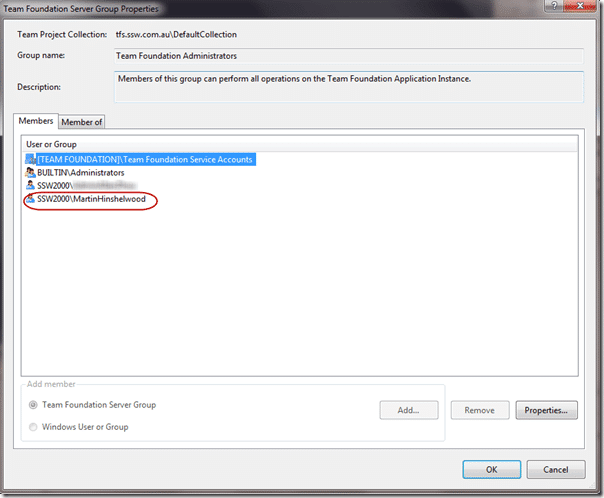
**Figure: Yes, I am in the administrators group on the server
** -
Am I in the Administration Console users list?
Figure: Yes, I am in the Administration Console users list
-
Have I reapplied the permissions in the Administration Console users list ticking all the options?
**Figure: Make sure you check all of the boxed if you want to have all the admin options
**
**Figure: Yes, I have made sure that all my options are correct.**
-
Am I in the Team Foundation administrators group?
**Figure: Yes, I am in the Team Foundation Administrators group
** -
Is my account explicitly SysAdmin on the Database server?
Figure: Yes, I do have explicit SysAdmin on the database
Can you guess what the problem was?
The command line window was not running as the administrator!
As with most other applications there should be an explicit error message that states:
“You are not currently running in administrator mode; please restart the command line with elevated privileges!”
This would have saved me 30 minutes, although I agree that I should change my name to Muppet and just be done with it.
Technorati Tags: ALM TFS Admin SSW TFS 2010
Smart Classifications
Each classification [Concepts, Categories, & Tags] was assigned using AI-powered semantic analysis and scored across relevance, depth, and alignment. Final decisions? Still human. Always traceable. Hover to see how it applies.
What to read next
TFS 2012 - Issue: Manage Group Membership missing from admin after TFS 2008 to TFS 2012 Upgrade
Explains how to restore missing group membership management in TFS 2012 after upgrading from TFS 2008 by manually adding permissions using …
Access denied for orchestration plan on Build
Explains how to resolve TFS build errors caused by missing write permissions for the Project Collection Build Service on orchestration …
Detecting agile theatre with real delivery signals
Why Most Companies Operating Models Fail in Dynamic Markets
A concise comparison of Predictive and Adaptive Operating Models, explaining why traditional structures fail in dynamic markets and how …
Don’t Manage Dependencies, Remove Them
Explains why dependencies are a sign of poor system design and outlines steps to eliminate them by aligning teams, clarifying ownership, and …
The Estimation Trap: How Tracking Accuracy Undermines Trust, Flow, and Value in Software Delivery
Tracking estimation accuracy in software delivery leads to mistrust, fear, and distorted behaviours. Focus on customer value, flow, and …
Flow of Value vs Flow of Work – Misnomer or Useful Shorthand?
Compares “flow of value” and “flow of work” in Kanban, explaining why only validated outcomes count as value and stressing the need for …
Why Outsourcing DevOps Fails, and How Real Engineering Excellence Starts With Your Team
Avoid DevOps vendor lock-in, discover how true engineering excellence starts with partnership, not outsourcing. Ready to transform your …