Most Scrum Teams that I encounter don’t do refinement of their Product Backlog and try to work on things that they don’t understand correctly. However, if you get to the Sprint Planning event and your backlog is not ready, then you are doing it wrong. If what you build is not of good quality then you should read about Defenition of Done.
Updated to reflect the 2020 Scrum Guide!
TL;DR
If you get to the Sprint Planning event and your Product Backlog Items for the next Sprint are not already of a size that can fit into the Sprint and fully understood by the Developers, then you are doing it wrong. You are heading for the rocks from the start, and you have no map of the shallows to prevent it.
Although the Scrum Guide does not define Refinement as an event, you should be doing it. You can come up with your Refinement event(s), or refine ad-hoc. Whatever you chose there is a simple measure of success. If your Developers looks at something within the next 2 Sprints on the backlog and they don’t understand it, then you have work to do.
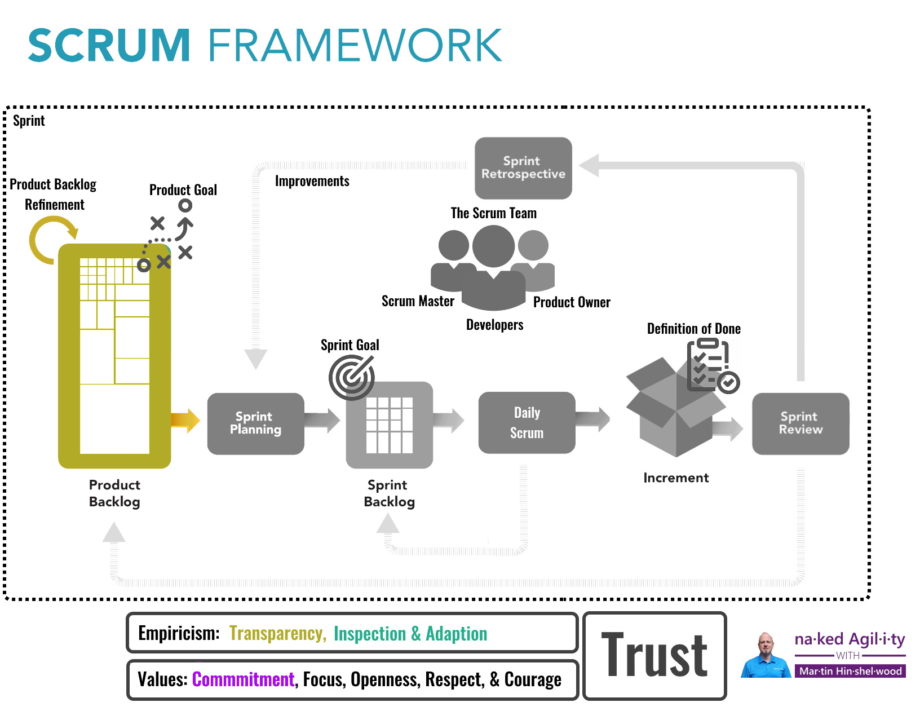
If you find that you can’t quite get things to fit and have to stagger iterations, or you are just not able to deliver at all, then a lack of refinement is usually at fault.
What does ready mean for a Product Backlog?
If the Developers does not understand the things that they are being asked to do how could they possibly agree that the items can fit in a Sprint? You will often find teams that don’t do refinement confused as to why they can’t get everything done in a Sprint. While we accept that in an empirical process like Scrum that we, know less upfront than we discover as we go, merely taking a guess and hoping for the best is decidedly unprofessional.
“Selecting how much can be completed within a Sprint may be challenging. However, the more the Developers know about their past performance, their upcoming capacity, and their Definition of Done, the more confident they will be in their Sprint forecasts.”
-ScrumGuides.org
While we don’t need a definition of ready, we do need a working agreement between the Product Owner and the Developers. In Scrum, the Developers are the ones selecting work for the Sprint, and they are the only ones that can decide what they can do. Developers should be empowered to refuse to take items from the backlog that either they do not understand, or are too big to be completed in a single sprint. In general, I would expect that a team take many items into their Sprint, so they need to be sized appropriately.
Ready Backlog just means that the Developers can select it with confidence.
How do you refine your backlog?
Refinement is not an explicit event in the Scrum Guide because it is something that can be different depending on the Product, Domain, or Technology. If you were to ask how much refinement you should do then the answer is “as much as you need and no more”. Too much refinement is waste, as it too little.
“Product Backlog refinement is the act of breaking down and further defining Product Backlog items into smaller more precise items. This is an ongoing activity to add details, such as a description, order, and size. Attributes often vary with the domain of work.”
The amount of time that Developers spend on refinement is based on the need. However, this need for refinement will vary over the life of the product and you should be spending as much time as your need while maximizing focus on the realisation of value. I have found that many teams that were not doing refinement in the past may need considerably more time to get their backlog into some semblance of order. Once it is in order, you are generally only maintaining a rolling Sprint projection, based on your effective planning horizon, of what you might achieve.
I usually run at least the first refinement as a guided workshop. By running one before a Sprint Planning most teams will see the value of it by the end of the next Sprint. For the workshop, I get the Scrum Team (Product Owner, Developers, & Scrum Master) into a room with any necessary subject matter experts and we merely open the existing backlog and review it. Start at the top and ask the Product Owner if this is the next most important thing? If not, find something that is. Then have the Product Owner read and explain it, then discuss and add details.
Any time the Product Owner deviates from the text that is in the Backlog Item, or adds more information, stop and have someone add that info to the Backlog Item. Ask the Developers to estimate the item, “Does this look like it can fit with many other friends into a single Sprint?”. If the answer is no, then you get to work breaking it down, reordering in the Product Backlog, and start refining again. You continue this process until the Developers agrees that there is enough backlog refined for the next 2 Sprints.
This enables your Product Owner to be able to plan future releases and your Developers to create an implementation plan for the current one.
How do you monitor your refinement effectiveness?
During the Sprint Planning event, your Developers should be able to quickly select many Product Backlog Items that go towards the chosen Sprint Goal and agree that they fit. If you can do this, and most of the time you get most (not all) of the Items delivered, then you are probably doing enough refinement. If you can’t, then you need to focus a little more on Refinement and making your Product Backlog ready.
If at your Sprint Review the Product Owner is always wanting to reject that Backlog Items are complete then there is unlikely to be enough refinement for the Development Team to understand what they are expected to do.
Smart Classifications
Each classification [Concepts, Categories, & Tags] was assigned using AI-powered semantic analysis and scored across relevance, depth, and alignment. Final decisions? Still human. Always traceable. Hover to see how it applies.
What to read next
Decoding Scrum Team Work: Balancing Sprint and Refinement Work
Explains how Scrum teams can balance Sprint work and Refinement, with strategies and visual tools to track, manage, and visualise both for …
The fallacy of the rejected backlog item
Explains why rejecting individual backlog items at Sprint Review is a misconception, highlighting Scrum’s focus on learning, collaboration, …
Getting started with a Definition of Done (DoD)
Explains how to create, apply, and improve a Definition of Done (DoD) in Scrum to ensure software quality, transparency, and consistent …
The Importance of Product Backlog Management in Today's Agile Landscape
Explains why effective product backlog management is vital in Agile, highlights common pitfalls, and offers practical tips to improve team …
Release planning and predictable delivery
Explores how agile teams can achieve predictable software delivery through quality focus, effective release planning, and continuous …
Too much refinement wastes time
Balancing backlog refinement prevents wasted effort and chaos. Aim for just enough detail so developers can plan sprints confidently without …
Detecting agile theatre with real delivery signals
Why Most Companies Operating Models Fail in Dynamic Markets
A concise comparison of Predictive and Adaptive Operating Models, explaining why traditional structures fail in dynamic markets and how …
Don’t Manage Dependencies, Remove Them
Explains why dependencies are a sign of poor system design and outlines steps to eliminate them by aligning teams, clarifying ownership, and …
The Estimation Trap: How Tracking Accuracy Undermines Trust, Flow, and Value in Software Delivery
Tracking estimation accuracy in software delivery leads to mistrust, fear, and distorted behaviours. Focus on customer value, flow, and …
Flow of Value vs Flow of Work – Misnomer or Useful Shorthand?
Compares “flow of value” and “flow of work” in Kanban, explaining why only validated outcomes count as value and stressing the need for …
Why Outsourcing DevOps Fails, and How Real Engineering Excellence Starts With Your Team
Avoid DevOps vendor lock-in, discover how true engineering excellence starts with partnership, not outsourcing. Ready to transform your …
The Definition of Done is a Commitment to Quality
Defines the Definition of Done in Scrum as a clear, shared standard for quality, ensuring increments are releasable, transparent, and …
Why Your Definition of “Done” Is Holding Back Quality, Agility, and Trust, And How to Raise the Bar
Is your team’s “done” really done? Discover how a clear, objective definition of done boosts quality, agility, and trust in product …
Acceptance Criteria vs Definition of Done: Why Getting This Right Builds Trust and Delivers Quality Faster
Stop confusing acceptance criteria with definition of done, learn the crucial difference to boost quality, speed, and trust in your agile …
How to Evolve Your Definition of Done: Start Small, Grow Smarter, and Build Lasting Momentum
Unlock a smarter Definition of Done, start small, evolve standards, and build team momentum without overwhelm. Discover how progress drives …
Why Most Transformations Fail Without Honest Conversations
Most transformations fail without open, honest conversations that address real issues, making transparency and tough dialogue essential for …
Why Your Definition of Done Is the Secret Weapon for Real Business Impact and Agile Growth
Transform your definition of done into a strategic advantage, deliver real value, reduce risk, and drive business impact with every sprint.
Why Most Companies Operating Models Fail in Dynamic Markets
A concise comparison of Predictive and Adaptive Operating Models, explaining why traditional structures fail in dynamic markets and how …
Don’t Manage Dependencies, Remove Them
Explains why dependencies are a sign of poor system design and outlines steps to eliminate them by aligning teams, clarifying ownership, and …
The Estimation Trap: How Tracking Accuracy Undermines Trust, Flow, and Value in Software Delivery
Tracking estimation accuracy in software delivery leads to mistrust, fear, and distorted behaviours. Focus on customer value, flow, and …
Kendall Guide - A System of Work for AI Adoption
Flow of Value vs Flow of Work – Misnomer or Useful Shorthand?
Compares “flow of value” and “flow of work” in Kanban, explaining why only validated outcomes count as value and stressing the need for …
Estimating Better in an Overloaded System Is a Poor Man’s Strategy
High work in progress (WIP) causes delays and unpredictability; improving estimates won’t help. Limiting WIP and focusing on flow is key to …
Why Most Companies Operating Models Fail in Dynamic Markets
A concise comparison of Predictive and Adaptive Operating Models, explaining why traditional structures fail in dynamic markets and how …
The Estimation Trap: How Tracking Accuracy Undermines Trust, Flow, and Value in Software Delivery
Tracking estimation accuracy in software delivery leads to mistrust, fear, and distorted behaviours. Focus on customer value, flow, and …
Getting Started with Objectives & Key Results
Learn how to successfully implement OKRs by aligning clear strategy, fostering transparency, empowering teams, focusing on outcomes, and …
OKR Guide - A Social Discipline for Shared Focus, Measurable Contribution, and Strategic Learning
A certification proves you’ve passed a test
Certifications show test-passing ability but don’t prove real-world product skills. Experience, judgement, and stakeholder influence matter …
Most companies still get Product Ownership wrong
Many organisations misunderstand Product Ownership, treating it as simple backlog management instead of a strategic, accountable role …