 When you create tasks in Scrum you are doing this within a time box and you tend to add only the information you need to remember what the task is. And the entire Team was at the meeting and were involved in the discussions around the task, so why do you need more?
Once you have accepted a task you should then add as much information as possible so that anyone can pick up that task; what if your numbers come up? Will you be into work the next day?

Figure: What if your numbers come up in the lottery?
What if the Team runs a syndicate and all your numbers come up? The point is that anything can happen and you need to protect the integrity of the project, the company and the Customer.
Add as much information to the task as you think is necessary for anyone to work on the task.
If you need to add rich text and images you can do this by attaching an email to the task .
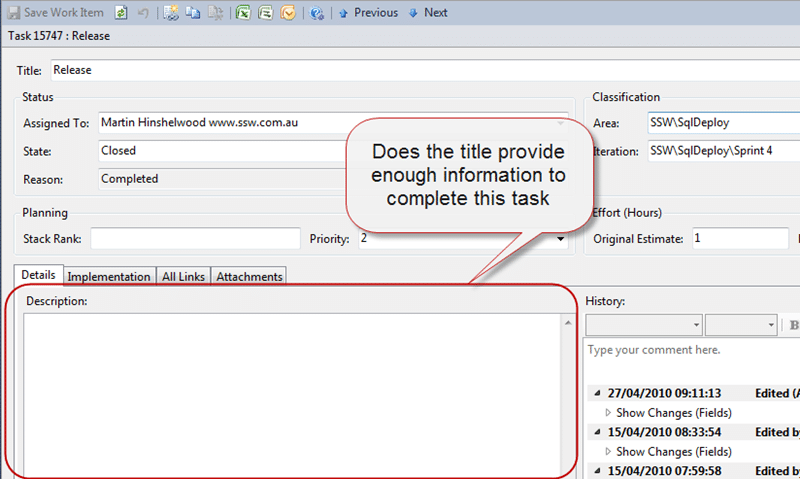
Figure: Bad example, there is not enough information for a non team member to complete this task
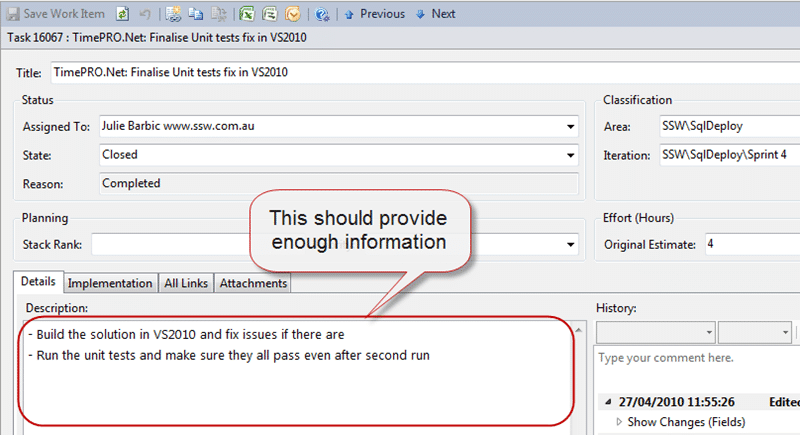
Figure: Julie provided a lot more information and another team should be able to pick this up.
This has been published as Do you know to ensure that relevant emails are attached to tasks in our Rules to Better Scrum using TFS .
Technorati Tags: Scrum SSW Rules TFS 2010 SSW SP 2010 SharePoint
Smart Classifications
Each classification [Concepts, Categories, & Tags] was assigned using AI-powered semantic analysis and scored across relevance, depth, and alignment. Final decisions? Still human. Always traceable. Hover to see how it applies.
What to read next
Combining Scrum, TFS2010 and Email to keep everyone in the loop
Explains how to integrate Scrum, TFS 2010, and email to share task details, maintain history, and keep all stakeholders informed throughout …
Do you know that every user story should have an owner?
Assigning an owner to each user story in Scrum ensures clear responsibility, better communication, and accountability throughout the sprint …
Do you have a contract between the Product Owner and the Team?
Explains the benefits of a Sprint Contract in Scrum, clarifying roles and agreements between Product Owner and Team to improve collaboration …
Avoid the Bug as Task anti-pattern in Azure DevOps
Explains why treating bugs as tasks in Azure DevOps is an anti-pattern, its impact on transparency, quality, and planning, and offers …
Mastering Agile: 3 Essential Strategies to Boost Your Team's Sprint Success
Learn three key Agile strategies: define clear completion criteria, avoid overcommitting in Sprints, and prioritise backlog refinement for …
Detecting agile theatre with real delivery signals
Why Most Companies Operating Models Fail in Dynamic Markets
A concise comparison of Predictive and Adaptive Operating Models, explaining why traditional structures fail in dynamic markets and how …
Don’t Manage Dependencies, Remove Them
Explains why dependencies are a sign of poor system design and outlines steps to eliminate them by aligning teams, clarifying ownership, and …
The Estimation Trap: How Tracking Accuracy Undermines Trust, Flow, and Value in Software Delivery
Tracking estimation accuracy in software delivery leads to mistrust, fear, and distorted behaviours. Focus on customer value, flow, and …
Flow of Value vs Flow of Work – Misnomer or Useful Shorthand?
Compares “flow of value” and “flow of work” in Kanban, explaining why only validated outcomes count as value and stressing the need for …
Why Outsourcing DevOps Fails, and How Real Engineering Excellence Starts With Your Team
Avoid DevOps vendor lock-in, discover how true engineering excellence starts with partnership, not outsourcing. Ready to transform your …
The Definition of Done is a Commitment to Quality
Defines the Definition of Done in Scrum as a clear, shared standard for quality, ensuring increments are releasable, transparent, and …
Why Your Definition of “Done” Is Holding Back Quality, Agility, and Trust, And How to Raise the Bar
Is your team’s “done” really done? Discover how a clear, objective definition of done boosts quality, agility, and trust in product …
Acceptance Criteria vs Definition of Done: Why Getting This Right Builds Trust and Delivers Quality Faster
Stop confusing acceptance criteria with definition of done, learn the crucial difference to boost quality, speed, and trust in your agile …
How to Evolve Your Definition of Done: Start Small, Grow Smarter, and Build Lasting Momentum
Unlock a smarter Definition of Done, start small, evolve standards, and build team momentum without overwhelm. Discover how progress drives …
Why Most Transformations Fail Without Honest Conversations
Most transformations fail without open, honest conversations that address real issues, making transparency and tough dialogue essential for …
Why Your Definition of Done Is the Secret Weapon for Real Business Impact and Agile Growth
Transform your definition of done into a strategic advantage, deliver real value, reduce risk, and drive business impact with every sprint.