 Working in Scrum it is useful to define a Sprint Contract between the Product Owner (PO) and the implementation Team. Doing this helps to improve common understanding in, and sometimes to enforce, the relationship between the PO and the Team.
Update 14th April 2010
- Rule added to Rules to better Scrum with TFS
This is simply an agreement between the PO for one Sprint and is not really a commercial contract and should be confirmed via an e-mail at the beginning of every Sprint.
“The implementation team agrees to do its best to deliver an agreed on set of features (scope) to a defined quality standard by the end of the sprint. (Ideally they deliver what they promised, or even a bit more.) The Product Owner agrees not to change his instructions before the end of the Sprint.”
- Agile Project management (http://agilesoftwaredevelopment.com/blog/peterstev/10-agile-contracts#Sprint )
Each of the Sprints in a Scrum project can be considered a mini-project that has Time (Sprint Length), Scope (Sprint Backlog), Quality (Definition of Done) and Cost (Team Size*Sprint Length). Only the scope can vary and this is measured every sprint.
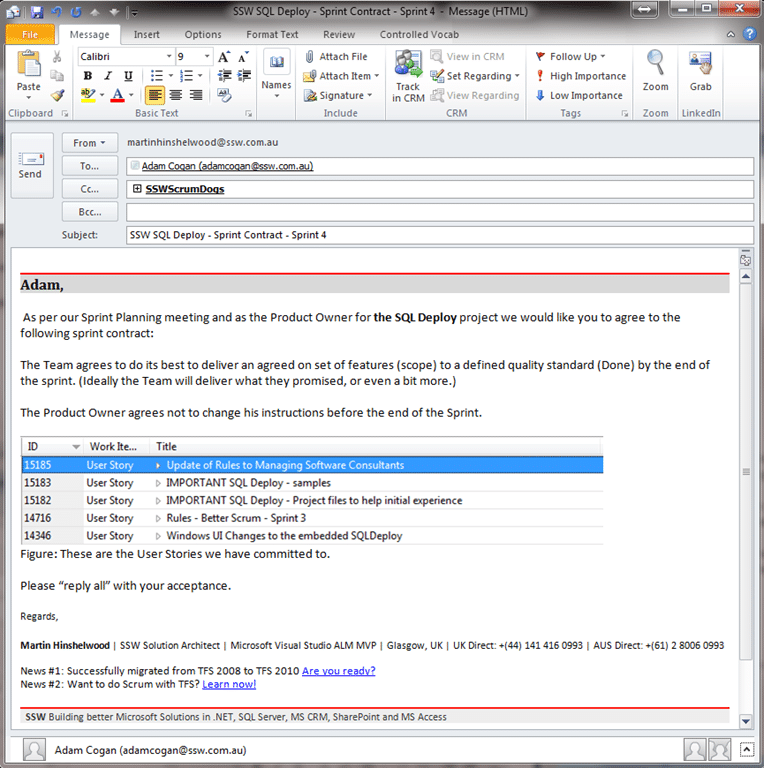
Figure: Good Example, the product owner should reply to the team and commit to the contract
Technorati Tags: SSW Scrum SSW Rules SP 2010 SharePoint
Smart Classifications
Each classification [Concepts, Categories, & Tags] was assigned using AI-powered semantic analysis and scored across relevance, depth, and alignment. Final decisions? Still human. Always traceable. Hover to see how it applies.
What to read next
Do you know that every user story should have an owner?
Assigning an owner to each user story in Scrum ensures clear responsibility, better communication, and accountability throughout the sprint …
Adventures in Scrum: Lesson 2 - For the record
Highlights the importance of clear communication and documenting disagreements in Scrum to prevent misunderstandings and failed sprints, …
Even Scrum should have detailed Task descriptions
Scrum tasks should include detailed descriptions so anyone can complete them, ensuring project continuity if team members are unavailable or …
Combining Scrum, TFS2010 and Email to keep everyone in the loop
Explains how to integrate Scrum, TFS 2010, and email to share task details, maintain history, and keep all stakeholders informed throughout …
Mastering Sprint Planning: Key Principles for Agile Success
Learn essential principles for effective Sprint planning in Agile, including understanding the product backlog, setting clear goals, and …
Detecting agile theatre with real delivery signals
Why Most Companies Operating Models Fail in Dynamic Markets
A concise comparison of Predictive and Adaptive Operating Models, explaining why traditional structures fail in dynamic markets and how …
Don’t Manage Dependencies, Remove Them
Explains why dependencies are a sign of poor system design and outlines steps to eliminate them by aligning teams, clarifying ownership, and …
The Estimation Trap: How Tracking Accuracy Undermines Trust, Flow, and Value in Software Delivery
Tracking estimation accuracy in software delivery leads to mistrust, fear, and distorted behaviours. Focus on customer value, flow, and …
Flow of Value vs Flow of Work – Misnomer or Useful Shorthand?
Compares “flow of value” and “flow of work” in Kanban, explaining why only validated outcomes count as value and stressing the need for …
Why Outsourcing DevOps Fails, and How Real Engineering Excellence Starts With Your Team
Avoid DevOps vendor lock-in, discover how true engineering excellence starts with partnership, not outsourcing. Ready to transform your …
The Definition of Done is a Commitment to Quality
Defines the Definition of Done in Scrum as a clear, shared standard for quality, ensuring increments are releasable, transparent, and …
Why Your Definition of “Done” Is Holding Back Quality, Agility, and Trust, And How to Raise the Bar
Is your team’s “done” really done? Discover how a clear, objective definition of done boosts quality, agility, and trust in product …
Acceptance Criteria vs Definition of Done: Why Getting This Right Builds Trust and Delivers Quality Faster
Stop confusing acceptance criteria with definition of done, learn the crucial difference to boost quality, speed, and trust in your agile …
How to Evolve Your Definition of Done: Start Small, Grow Smarter, and Build Lasting Momentum
Unlock a smarter Definition of Done, start small, evolve standards, and build team momentum without overwhelm. Discover how progress drives …
Why Most Transformations Fail Without Honest Conversations
Most transformations fail without open, honest conversations that address real issues, making transparency and tough dialogue essential for …
Why Your Definition of Done Is the Secret Weapon for Real Business Impact and Agile Growth
Transform your definition of done into a strategic advantage, deliver real value, reduce risk, and drive business impact with every sprint.