Over the past decade, a recurring query has been echoing in my ears: “How can we normalise Story Points across teams so that we can look across and maybe compare teams?” It’s high time we address this.
TLDR;
Story Points, while subjective, can be a valuable tool for team discussions and understanding. However, they shouldn’t be the primary metric for comparing teams or predicting future deliverables. Instead, focus on objective metrics like throughput, to gauge and optimise team performance.
These are not the metrics that you are looking for!
First and foremost, Story Points are inherently subjective. They’re influenced by individual perceptions, making them unsuitable for broad comparisons or future projections. While they might offer a vague direction, they’re often misused in planning and measuring.
The essence of agile frameworks like Scrum is value delivery, and the correlation between the subjective nature of story points and their velocity doesn’t necessarily equate to the value delivered. There are better choices for teams aiming to optimise their value delivery than relying solely on Story Points and Velocity.
But is there any value in Story Points?
Aye, there is. In my experience, Story Points can be a great tool during backlog item refinement. They foster discussions, highlighting what’s known and, more importantly, what’s not: Outliers during planning poker often signal gaps in understanding.
Tools like Story Points and Planning Poker can be invaluable in understanding when to dissect items further and spark discussions during refinement. I would expect teams to shift more towards right-sizing, ensuring that backlog items are feasible within a Sprint, as they gain more experience and understanding of the product, its domain, and the technology used.
A Story of Flow and Value
The crux of this discourse lies in two vectors: throughput and value.
-
Throughput is a tangible measure of items delivered over time.
-
Value, on the other hand, is a more elusive measure of the anticipated benefits from system changes.
It’s straightforward to gauge the throughput of backlog items and their flow. By noting when work enters and exits the system, we can derive the four pivotal flow metrics:
-
Throughput
-
Work Item Age
-
Work In Process
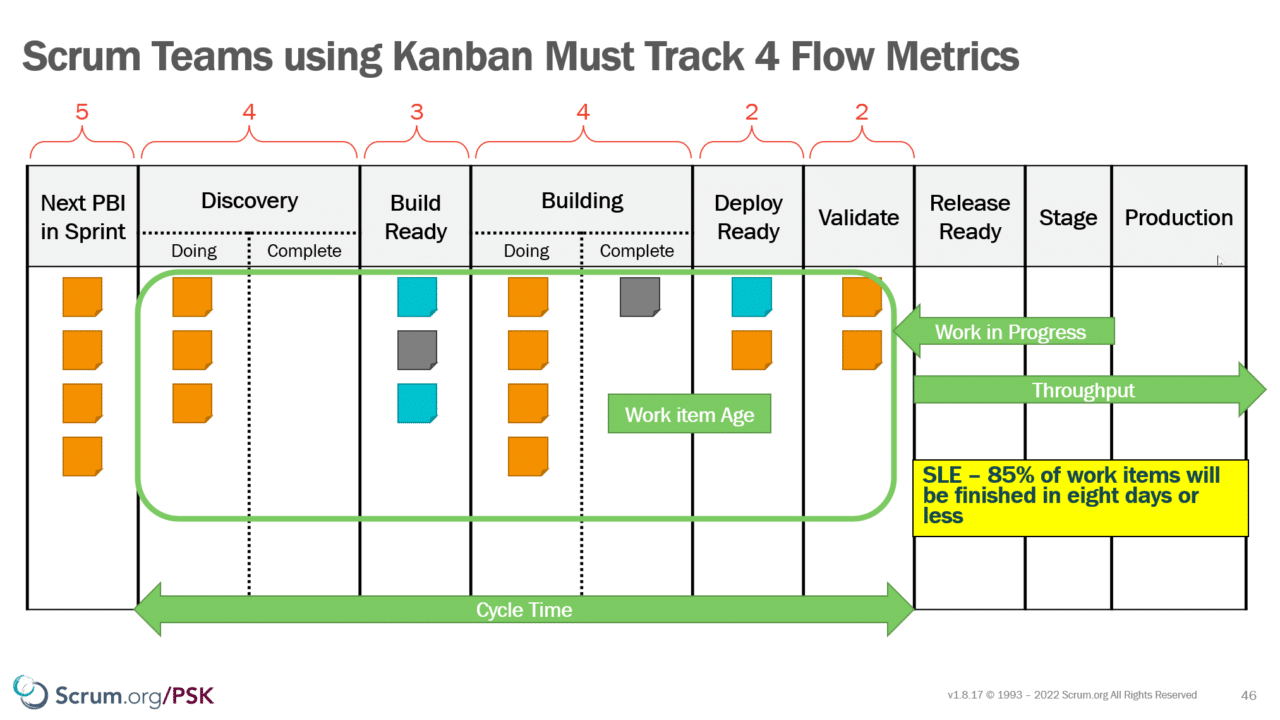
Such metrics empower us to make informed decisions rooted in tangible data. They allow us to pinpoint potential issues, identify items needing further breakdown, and employ probabilistic forecasting for future projections.
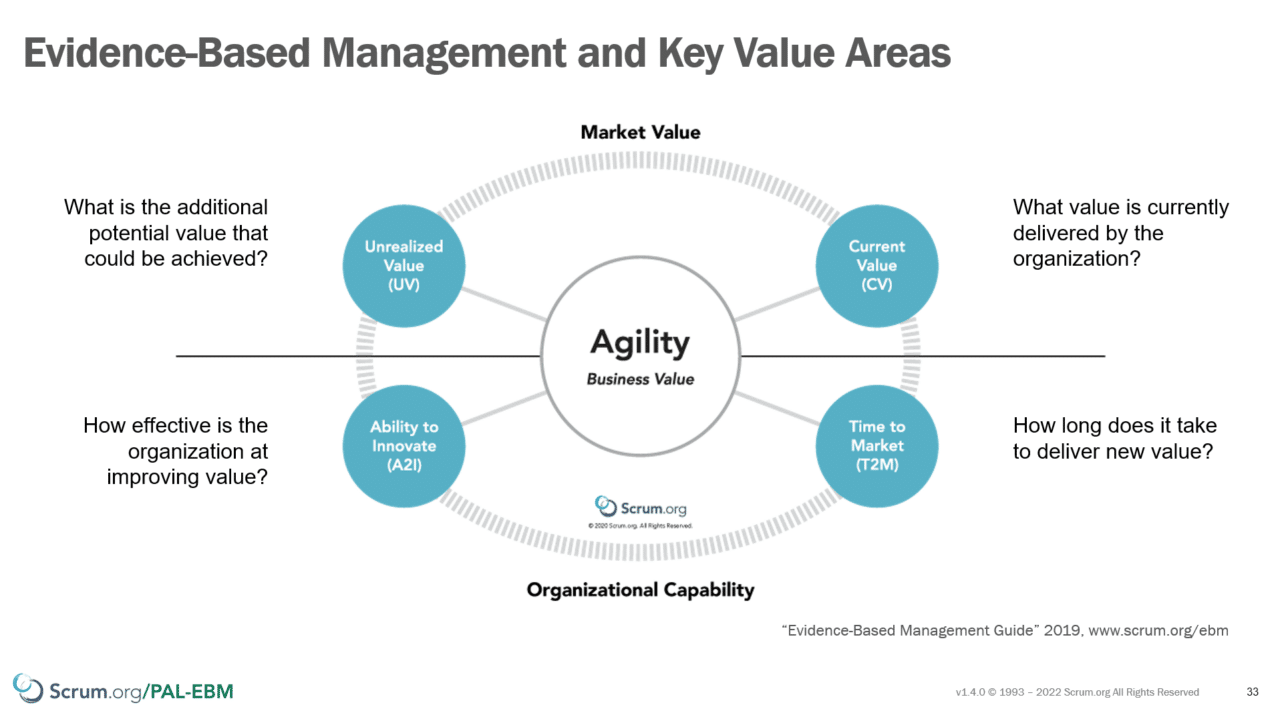
Simultaneously, to truly maximise team output, we must also focus on the value of the work. Given its subjective nature, defining value can be multifaceted. A practical approach is to examine the four primary value areas from evidence-based management practices:
-
Current Value - Evaluating the existing product’s value. Is it meeting customer expectations?
-
Unrealised Value - Identifying gaps in your product that could be filled.
-
Time to Market - Assessing the speed from ideation to user engagement. Dormant value is essentially no value.
-
Ability to Innovate - Determining the balance between maintenance and innovation.
The ultimate goal is to enhance both throughput and value concurrently. Striking a balance is crucial; we neither want sluggish excellence nor a barrage of mediocrity.
Smart Classifications
Each classification [Concepts, Categories, & Tags] was assigned using AI-powered semantic analysis and scored across relevance, depth, and alignment. Final decisions? Still human. Always traceable. Hover to see how it applies.
What to read next
Story Points: A Ghost of Agile Past
Explores the problems with story points in Agile, their impact on team behaviour, and why flow metrics offer a better way to measure …
Ditching Agile Banditry: Why Story Points and Velocity Metrics Are Undermining Your Team's Success
Explores how relying on story points and velocity can harm Agile teams, advocating for objective metrics like cycle time and throughput to …
Avoiding Agile Banditry: Why Story Points and Velocity Are Misleading Metrics
Explains why story points and velocity can mislead Agile teams, and recommends focusing on throughput, cycle time, and customer value for …
Scrum is like communism, it doesn't work. Myth 2
Explains why story points are often misunderstood in Scrum, clarifies their intended use, and offers practical advice for more effective …
Story Points & Velocity are a sign of an unsuccessful team
Explains why relying on story points and velocity signals team immaturity in Scrum, and highlights better ways to build confidence and …
Rethinking Agile: Why Story Points, Team Sizes, and Emergent Architecture Need a Fresh Perspective
Explores the limitations of story points, optimal team sizes, and the benefits of emergent architecture for improving agile practices and …
Detecting agile theatre with real delivery signals
Why Most Companies Operating Models Fail in Dynamic Markets
A concise comparison of Predictive and Adaptive Operating Models, explaining why traditional structures fail in dynamic markets and how …
Don’t Manage Dependencies, Remove Them
Explains why dependencies are a sign of poor system design and outlines steps to eliminate them by aligning teams, clarifying ownership, and …
The Estimation Trap: How Tracking Accuracy Undermines Trust, Flow, and Value in Software Delivery
Tracking estimation accuracy in software delivery leads to mistrust, fear, and distorted behaviours. Focus on customer value, flow, and …
Flow of Value vs Flow of Work – Misnomer or Useful Shorthand?
Compares “flow of value” and “flow of work” in Kanban, explaining why only validated outcomes count as value and stressing the need for …
Why Outsourcing DevOps Fails, and How Real Engineering Excellence Starts With Your Team
Avoid DevOps vendor lock-in, discover how true engineering excellence starts with partnership, not outsourcing. Ready to transform your …
Why Most Companies Operating Models Fail in Dynamic Markets
A concise comparison of Predictive and Adaptive Operating Models, explaining why traditional structures fail in dynamic markets and how …
Don’t Manage Dependencies, Remove Them
Explains why dependencies are a sign of poor system design and outlines steps to eliminate them by aligning teams, clarifying ownership, and …
The Estimation Trap: How Tracking Accuracy Undermines Trust, Flow, and Value in Software Delivery
Tracking estimation accuracy in software delivery leads to mistrust, fear, and distorted behaviours. Focus on customer value, flow, and …
Kendall Guide - A System of Work for AI Adoption
Flow of Value vs Flow of Work – Misnomer or Useful Shorthand?
Compares “flow of value” and “flow of work” in Kanban, explaining why only validated outcomes count as value and stressing the need for …
Estimating Better in an Overloaded System Is a Poor Man’s Strategy
High work in progress (WIP) causes delays and unpredictability; improving estimates won’t help. Limiting WIP and focusing on flow is key to …
Why Most Companies Operating Models Fail in Dynamic Markets
A concise comparison of Predictive and Adaptive Operating Models, explaining why traditional structures fail in dynamic markets and how …
The Estimation Trap: How Tracking Accuracy Undermines Trust, Flow, and Value in Software Delivery
Tracking estimation accuracy in software delivery leads to mistrust, fear, and distorted behaviours. Focus on customer value, flow, and …
Getting Started with Objectives & Key Results
Learn how to successfully implement OKRs by aligning clear strategy, fostering transparency, empowering teams, focusing on outcomes, and …
OKR Guide - A Social Discipline for Shared Focus, Measurable Contribution, and Strategic Learning
A certification proves you’ve passed a test
Certifications show test-passing ability but don’t prove real-world product skills. Experience, judgement, and stakeholder influence matter …
Most companies still get Product Ownership wrong
Many organisations misunderstand Product Ownership, treating it as simple backlog management instead of a strategic, accountable role …
Detecting agile theatre with real delivery signals
Don’t Manage Dependencies, Remove Them
Explains why dependencies are a sign of poor system design and outlines steps to eliminate them by aligning teams, clarifying ownership, and …
The Estimation Trap: How Tracking Accuracy Undermines Trust, Flow, and Value in Software Delivery
Tracking estimation accuracy in software delivery leads to mistrust, fear, and distorted behaviours. Focus on customer value, flow, and …
Flow of Value vs Flow of Work – Misnomer or Useful Shorthand?
Compares “flow of value” and “flow of work” in Kanban, explaining why only validated outcomes count as value and stressing the need for …
Why Outsourcing DevOps Fails, and How Real Engineering Excellence Starts With Your Team
Avoid DevOps vendor lock-in, discover how true engineering excellence starts with partnership, not outsourcing. Ready to transform your …
Estimating Better in an Overloaded System Is a Poor Man’s Strategy
High work in progress (WIP) causes delays and unpredictability; improving estimates won’t help. Limiting WIP and focusing on flow is key to …