In modern software development the idea of the topic branch is an essecial one. It is your gatekeeper to preventing Conway’s Law and an engineering structure that mirrors your organisational boundaries. Frequent integration through topic branches helps break down silos, encouraging cross-team collaboration and reducing the tendency for the software architecture to reflect the organisation’s communication paths.
A topic branch is a short-lived, focused branch in your source control repository that isolates a single unit of developer work. This is not a month-long feature branch. This is not “we’ll merge it someday” work. A topic branch is something you code, test, and integrate in a few hours or, at most, a couple of days.
The moment your topic branch stretches beyond a few days, take it as a warning:
- Integration will get harder.
- Merge conflicts will multiply.
- Your risk of defects or unintended behaviours will spike.
- Reviewing and validating costs more
If you let a branch sit for too long, you are building up integration debt that will bite you later. Topic branches, and thinking about them as just that, topics, is an essential practice in modern software engineering.
The Strategic importance of Topic Branches
We want to consistently emphasised the importance of technical practices that enable flow, adaptability, and resilience in software teams. Whether addressing trunk-based development, continuous delivery, or engineering excellence, the message remains the same: discipline in the small enables success in the large. Topic branches fit directly into this pattern. They are not just a coder habit; they are a deliberate tool that reinforces modularity, integration, and continuous feedback, all cornerstones of modern software delivery.
From a technical leadership perspective, topic branches are pivotal because they enable:
- Modularity , you isolate changes to a narrow scope.
- Continuous delivery , you keep the mainline ready for release.
- Clear code reviews , you limit pull requests to atomic, understandable units.
- Collaborative accountability , the team shares responsibility for integrating small changes frequently.
- Support for agile development practices , you align technical work with the team’s tactical Sprint Goals and Product Goals.
Without topic branches, you create a fragile system of work. Without topic branches, you make integration harder. Without topic branches, you slow down your delivery pipeline and increase the chance of failure.
Practical Patterns for Tactical Implementation of Topic Branches
Building on the strategic importance we need actionable patterns that technical leaders and teams can apply. It is not enough to understand why topic branches matter; you need pragmatic, grounded approaches that translate strategy into engineering practice. For most teams and most projects, GitHub Flow (the branching model, not the cloud tool) is the most effective model. It is a trunk-based model with minimal overhead and complexity. GitHub Flow treats the main branch as the production-ready line and uses small, short-lived topic branches for all work.

You branch off main, do your small unit of work, push frequently, and merge back as soon as possible , ideally the same day, or next day at the latest. Your branch is:
- Focused on a single task or issue.
- Continuously tested (locally and via CI).
- Reintegrated quickly to avoid drift.
- Reinforces context disapline
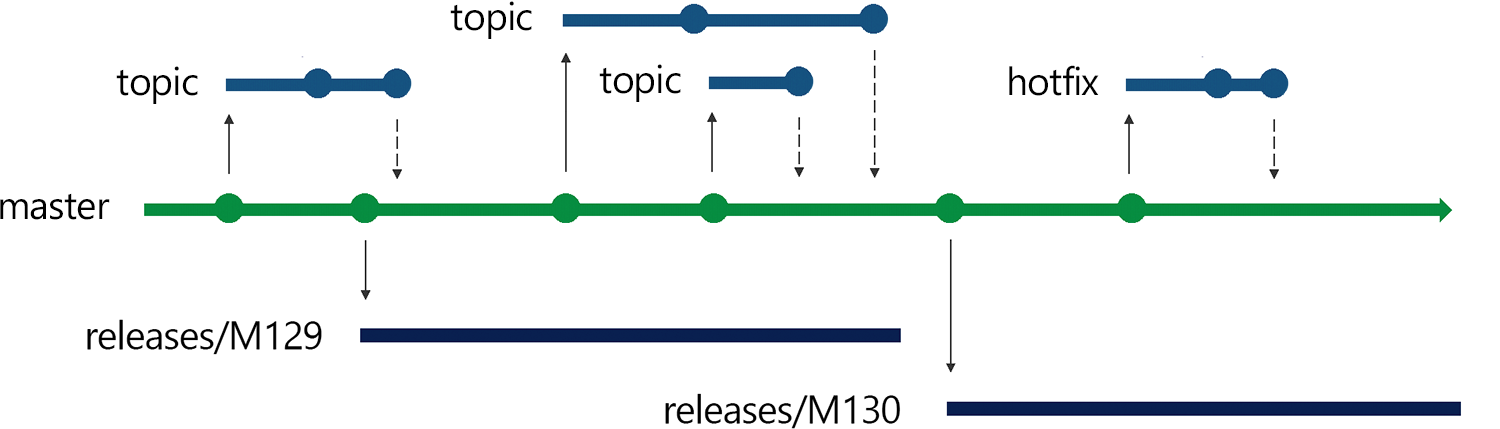
If you have a larger application with more engineers and the need to make changes in the production line, then Microsoft’s Release Flow, which is almost identical to “Github Flow” with the addition of a versioned release branch. One could say that Release Flow inherits and extends Github Flow.
Compare this to the traditional Git Flow approach that models less mature braching stratagies, which adds layers of feature, develop, release, and hotfix branches. While Git Flow can still be useful in some legacy or non-continuous delivery setups, it introduces far more overhead and complexity. It reflects a strategy from the pre-CD world.
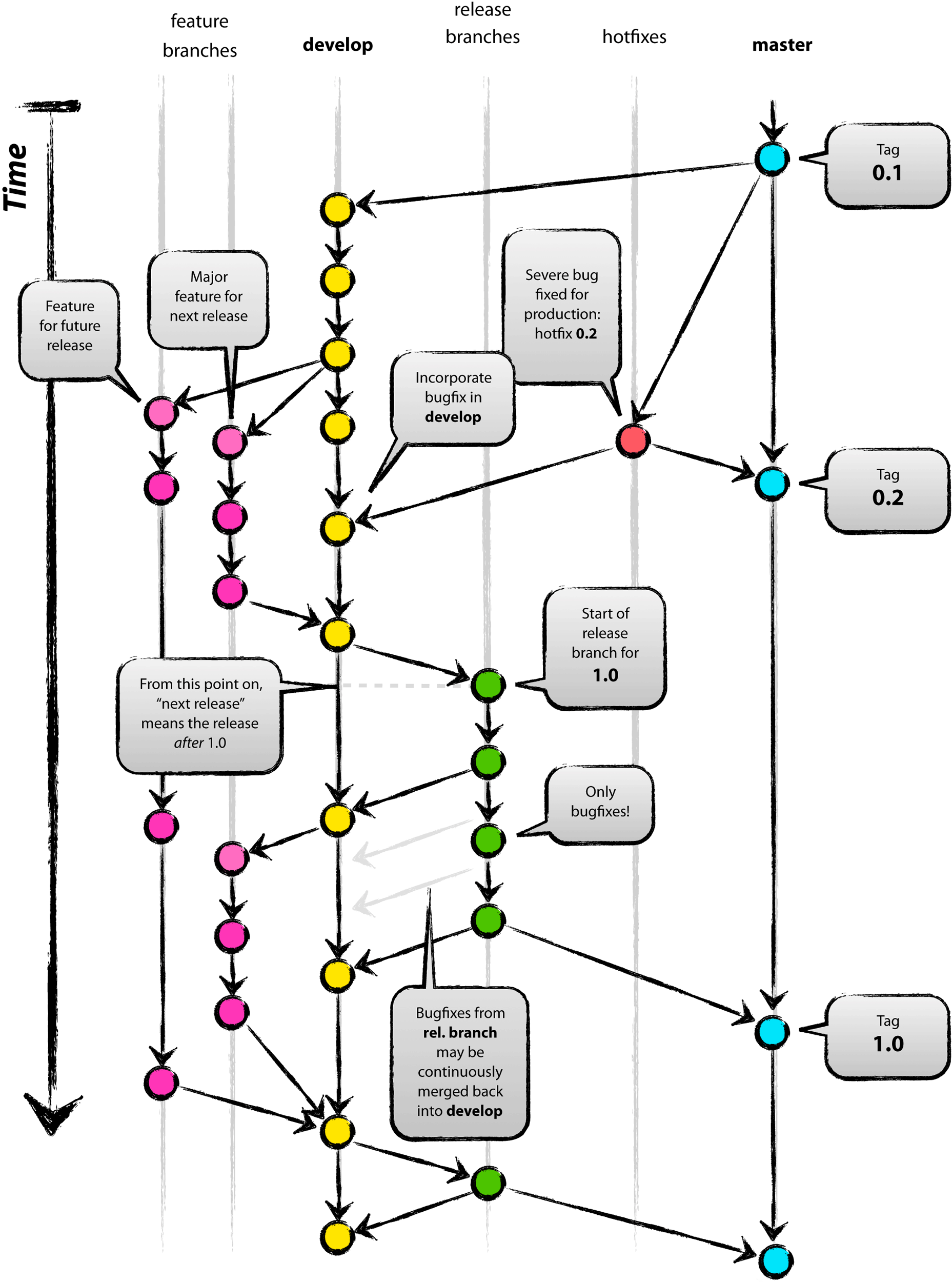
Gitflow Flow, and its derivatives, simplifies this: fewer long-lived branches, fewer merge headaches, more emphasis on incremental delivery.
Leading change through Branching Stratagy
If you are leading a team, the presence or absence of disciplined topic branching tells you a lot.
- Short-lived topic branches = a team practising modularity, integration, continuous feedback, and accountability.
- Long-lived feature branches = a team accumulating integration risk, delaying delivery, and likely violating agile principles.
You need to push the team to keep branches small, focused, and short-lived. Review your branching strategy regularly. Make sure it supports, not undermines, your goals of flow, agility, and quality. And above all make sure its clear what each branch is for and how it should be used.
If your team is struggling with long-lived branches, get serious:
- Introduce trunk-based development practices with GitHub Flow or Release Flow.
- Enforce limits on branch lifespan.
- Tighten your CI/CD loops.
- Teach your team the cost of integration delay.
Remember: your branching strategy is not just a technical choice. It is a critical enabler of continuous value delivery.
Smart Classifications
Each classification [Concepts, Categories, & Tags] was assigned using AI-powered semantic analysis and scored across relevance, depth, and alignment. Final decisions? Still human. Always traceable. Hover to see how it applies.
What to read next
Stop Promoting Branches
Explains why promoting code through multiple branches slows delivery, increases risk, and suggests GitHub Flow or Release Flow as simpler, …
Avoid the pick-n-mix branching anti-pattern
Explains the risks of the pick-n-mix branching anti-pattern in source control, its impact on code quality, and recommends feature branching …
Too many teams overcomplicate their branching strategies
Learn why simple branching strategies like GitHub Flow and Release Flow help teams deliver faster, reduce risk, and avoid the pitfalls of …
Guidance - Branching for each Sprint
Explains how using a separate version control branch for each sprint in Scrum improves code stability, release management, and team …
Best Branching Strategies for Development Teams Explained
Explains why environment-based branching slows development, and recommends using feature flags and progressive rollouts for simpler, faster, …
Branch promotion is a relic of slow, manual software delivery
Explains why modern software teams avoid branch promotion, using continuous integration, feature flags, and production-like testing to …
Detecting agile theatre with real delivery signals
Why Most Companies Operating Models Fail in Dynamic Markets
A concise comparison of Predictive and Adaptive Operating Models, explaining why traditional structures fail in dynamic markets and how …
Don’t Manage Dependencies, Remove Them
Explains why dependencies are a sign of poor system design and outlines steps to eliminate them by aligning teams, clarifying ownership, and …
The Estimation Trap: How Tracking Accuracy Undermines Trust, Flow, and Value in Software Delivery
Tracking estimation accuracy in software delivery leads to mistrust, fear, and distorted behaviours. Focus on customer value, flow, and …
Flow of Value vs Flow of Work – Misnomer or Useful Shorthand?
Compares “flow of value” and “flow of work” in Kanban, explaining why only validated outcomes count as value and stressing the need for …
Why Outsourcing DevOps Fails, and How Real Engineering Excellence Starts With Your Team
Avoid DevOps vendor lock-in, discover how true engineering excellence starts with partnership, not outsourcing. Ready to transform your …
Detecting agile theatre with real delivery signals
Don’t Manage Dependencies, Remove Them
Explains why dependencies are a sign of poor system design and outlines steps to eliminate them by aligning teams, clarifying ownership, and …
The Estimation Trap: How Tracking Accuracy Undermines Trust, Flow, and Value in Software Delivery
Tracking estimation accuracy in software delivery leads to mistrust, fear, and distorted behaviours. Focus on customer value, flow, and …
Flow of Value vs Flow of Work – Misnomer or Useful Shorthand?
Compares “flow of value” and “flow of work” in Kanban, explaining why only validated outcomes count as value and stressing the need for …
Why Outsourcing DevOps Fails, and How Real Engineering Excellence Starts With Your Team
Avoid DevOps vendor lock-in, discover how true engineering excellence starts with partnership, not outsourcing. Ready to transform your …
Estimating Better in an Overloaded System Is a Poor Man’s Strategy
High work in progress (WIP) causes delays and unpredictability; improving estimates won’t help. Limiting WIP and focusing on flow is key to …
Don’t Manage Dependencies, Remove Them
Explains why dependencies are a sign of poor system design and outlines steps to eliminate them by aligning teams, clarifying ownership, and …
Why Outsourcing DevOps Fails, and How Real Engineering Excellence Starts With Your Team
Avoid DevOps vendor lock-in, discover how true engineering excellence starts with partnership, not outsourcing. Ready to transform your …
Why Big Bang Rewrites Fail: How Sustainable Change and Engineering Excellence Transform Legacy Systems
Ditch the Big Bang rewrite. Discover why sustainable, in-place change drives true engineering excellence and lasting transformation in your …
Is Agile Really Just a Mindset?
Explores Agile as a disciplined system of delivery, emphasizing engineering excellence, CI/CD, observability, and system design over mindset …
Telling People What to Do Is Not Leadership. It’s a Failure of System Design
Explores why real leadership means designing systems that enable team autonomy, flow, and accountability, rather than relying on …
From Legacy Pain to Modern DevOps: My Proven Roadmap for Real Engineering Transformation
Transform legacy engineering with a proven, step-by-step approach, learn how to automate, adapt, and build a resilient, modern DevOps …
Why Most Companies Operating Models Fail in Dynamic Markets
A concise comparison of Predictive and Adaptive Operating Models, explaining why traditional structures fail in dynamic markets and how …
Don’t Manage Dependencies, Remove Them
Explains why dependencies are a sign of poor system design and outlines steps to eliminate them by aligning teams, clarifying ownership, and …
The Estimation Trap: How Tracking Accuracy Undermines Trust, Flow, and Value in Software Delivery
Tracking estimation accuracy in software delivery leads to mistrust, fear, and distorted behaviours. Focus on customer value, flow, and …
Kendall Guide - A System of Work for AI Adoption
Flow of Value vs Flow of Work – Misnomer or Useful Shorthand?
Compares “flow of value” and “flow of work” in Kanban, explaining why only validated outcomes count as value and stressing the need for …
Estimating Better in an Overloaded System Is a Poor Man’s Strategy
High work in progress (WIP) causes delays and unpredictability; improving estimates won’t help. Limiting WIP and focusing on flow is key to …