In the empirical world, we have 3 key skill areas of accountability that are needed to effectively deliver products of the highest possible value! We need Influencers that can provide leadership and create environments within which groups of people can organise the work. I consider this the Leadership Track where you have Scrum Masters, Coaches, and CEO. We need Entrepreneurs who can have a vision and project knowledge and understanding of that vision to the people that need to make that vision happen. This is the Value Track and may be made up of Product Owners, Analysts, and Subject Matter Experts. Last we have the Makers who are the ones who do the work that brings the product to life. They are on the Technical Track and focus on turning the vision into a reality. They have many skills and may have coders, testers, and other experts…
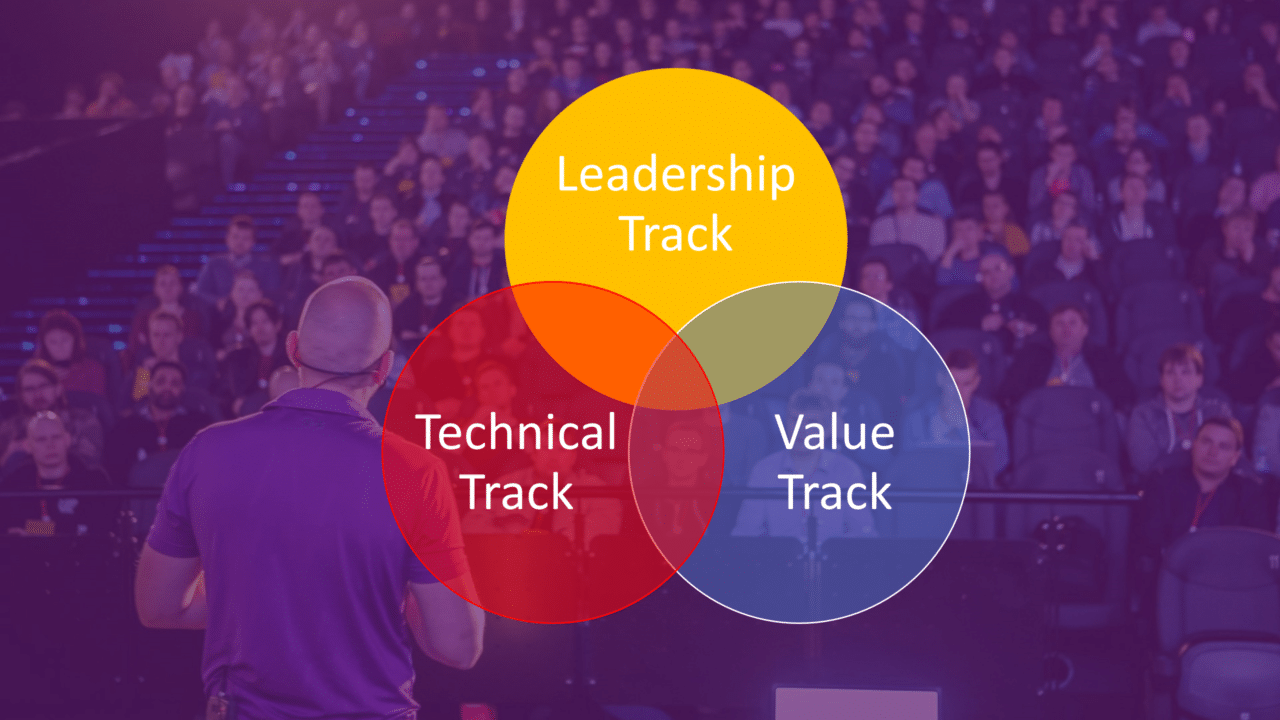
To have a successful company we need all three tracks to exist in the correct balance!
Scrum is made up of Influencers, Entrepreneurs, and Makers
Ultimately what do you care about? Do you care about the people, the product, or the work? You have lots of choices here, and you can always cross between these tracks, however, there should be progression and growth in each of them. You should not have to change track to grow.
Leadership Track ( Influencer )
The job of folks on the Leadership Track is to create an environment within which we can create products of the highest possible value within the bounds of our organisational constraints.
Those on the Leadership Track have often had experience in both the Value Track and the Technical Track and are familiar with the difficulties of both. They focus on enacting change in the organisation that makes others lives easier and focus on inspiring them to greatness.
Job Titles that might exist in the Leadership Track: Scrum Master, Manager, Agile Coach, Human Resources, CEO, Vice President, Practice Lead
Our Training for the Leadership Track
[wpv-view name=“2021-courseview” limit=“5” wpvrelatedto=“45953”]
Value Track ( Entrepreneurs )
The job of folks in the Value Track is to maximise the value delivered in the product.
Those on the Value Track should have experience in the Business Domain, and be experts in the product. Ideally, they have an entrepreneurial spirit and are adept at experimentation and understanding that decision needs to be made based on data.
Job Titles that might exist in the Value Track: Business Analysis, Product Owner, User Experience Designer, Subject Matter Expert
Our Content for the Value Track
[wpv-view name=“2021-postlist” limit=“5” wpvrelatedto=“45955”]
Technical Track ( Makers)
The job of folks in the Technical Track is to create a usable product every iteration.
Those on the Technical Track should have experience in the Technical Domain and some knowledge of the Business Domain. Ideally, they have a broad set of technical skills that allows them to work in any part of the product and some deep expertise that they have or are seeking, mastery over.
Job Titles that might exist in the Value Track: Coders, UX Designers, Testers, Security Specialists
Our Training for the Value Track
[wpv-view name=“2021-courseview” limit=“5” wpvrelatedto=“45954”]
Upcoming Training Opportunities
We love training and have many classes! Most of our classes are private for customer, but we also have a few public classes that you can join.
[wpv-view name=“2021-courseschedule-2”]
Smart Classifications
Each classification [Concepts, Categories, & Tags] was assigned using AI-powered semantic analysis and scored across relevance, depth, and alignment. Final decisions? Still human. Always traceable. Hover to see how it applies.
What to read next
If you could teach just one thing about Scrum, what would it be?
The most important aspect of Scrum is empiricism, using transparency, inspection, and adaptation to navigate complexity and drive effective …
What is the most valuable thing you have learned through training people?
Training people worldwide reveals that organisations face similar challenges when adopting agile and scrum, highlighting the universal …
Why is the Professional Agile Leadership - Essentials course a natural evolution for an experienced Scrum Master?
Explains how the Professional Agile Leadership – Essentials course helps experienced Scrum Masters gain leadership skills, understand …
What will you learn on the professional scrum master course?
Gain practical skills and deep understanding of the scrum master role, scrum theory, empiricism, team dynamics, and delivering value in …
Great Scrum Masters Need Technical, Business, and Organisational Mastery
Scrum Masters are most effective when they combine leadership skills with technical, business, and organisational mastery to support teams, …
Detecting agile theatre with real delivery signals
Why Most Companies Operating Models Fail in Dynamic Markets
A concise comparison of Predictive and Adaptive Operating Models, explaining why traditional structures fail in dynamic markets and how …
Don’t Manage Dependencies, Remove Them
Explains why dependencies are a sign of poor system design and outlines steps to eliminate them by aligning teams, clarifying ownership, and …
The Estimation Trap: How Tracking Accuracy Undermines Trust, Flow, and Value in Software Delivery
Tracking estimation accuracy in software delivery leads to mistrust, fear, and distorted behaviours. Focus on customer value, flow, and …
Flow of Value vs Flow of Work – Misnomer or Useful Shorthand?
Compares “flow of value” and “flow of work” in Kanban, explaining why only validated outcomes count as value and stressing the need for …
Why Outsourcing DevOps Fails, and How Real Engineering Excellence Starts With Your Team
Avoid DevOps vendor lock-in, discover how true engineering excellence starts with partnership, not outsourcing. Ready to transform your …
Why Most Companies Operating Models Fail in Dynamic Markets
A concise comparison of Predictive and Adaptive Operating Models, explaining why traditional structures fail in dynamic markets and how …
Getting Started with Objectives & Key Results
Learn how to successfully implement OKRs by aligning clear strategy, fostering transparency, empowering teams, focusing on outcomes, and …
Futureproof Leadership: How CTOs Can Cut Through the Noise and Lead with Clarity, Confidence, and Culture
Struggling with tech change? Discover how clarity, evidence, and culture can futureproof your team, no chasing trends, just smart …
From Burnout to Breakthrough: How CTOs Can Lead with Clarity, Resilience, and Real Innovation
Feeling overwhelmed as a tech leader? Discover how to shift from chaos to clarity and build resilient, future-ready teams, without burning …
Human and AI Agency in Adaptive Systems: Strategy Before Optimisation
Explores the distinct roles of human and AI agency in adaptive systems, emphasising human-led strategy and accountability versus AI-driven …
Stop Chasing Trends: How Real Agility and DevOps Build Resilient, Adaptable Teams
Stop chasing trends, build real agility. Discover how DevOps and agile create resilient teams, smoother delivery, and sustainable …
Why Most Companies Operating Models Fail in Dynamic Markets
A concise comparison of Predictive and Adaptive Operating Models, explaining why traditional structures fail in dynamic markets and how …
Don’t Manage Dependencies, Remove Them
Explains why dependencies are a sign of poor system design and outlines steps to eliminate them by aligning teams, clarifying ownership, and …
The Estimation Trap: How Tracking Accuracy Undermines Trust, Flow, and Value in Software Delivery
Tracking estimation accuracy in software delivery leads to mistrust, fear, and distorted behaviours. Focus on customer value, flow, and …
Kendall Guide - A System of Work for AI Adoption
Flow of Value vs Flow of Work – Misnomer or Useful Shorthand?
Compares “flow of value” and “flow of work” in Kanban, explaining why only validated outcomes count as value and stressing the need for …
Estimating Better in an Overloaded System Is a Poor Man’s Strategy
High work in progress (WIP) causes delays and unpredictability; improving estimates won’t help. Limiting WIP and focusing on flow is key to …