Before the “Professional Scrum Foundations ” course ever existed I was tasked with delivering a practical Scrum foundation course for our customers. I came up with a 2 day “Scrum Foundation” course that included lots of practical exercises and leveraged the existing Scrum Open exam. But why would you want it and is that all you need?
It is hard to adopt Scrum. You just have to read Ken’s “Scrum is hard and Disruptive” to understand just how hard!
But is that bad?
The reason that more organisations start looking hard at Agile and Scrum adoption is that we, as an industry, have lost the trust of business. The reason that we have lost the trust of business is that we (the IT industry) have proven time and again that we are:
- unable to deliver on time
- unable to deliver on budget
- unable to deliver what the business need
Is it any wonder that business does not trust us?
- Scrum is a framework for iterative, incremental development using cross-functional, self-managing teams. It is built on industry best practices, lean thinking, and empirical process control.
- Scrum is optimized for high yield product management and product development. Scrum is particularly appropriate for high risk, complex, large projects and can be used when other parts of the endeavour are hardware or even waterfall development.
- If waterfall suits current needs, continue using it.
- An enterprise can use Scrum as a tool to become the best product development and management organization in its market. Scrum will highlight every deficiency and impediment that the enterprise has so the enterprise can fix them and change into such an organization.
- Whenever an enterprise modifies or only partially implements Scrum, it is hiding or
obscuring one or more dysfunctionalities that restrict its competence in product
development and management.- The iterative, incremental nature of Scrum puts stress on the product development organization to improve its engineering skills and on the product management organization to optimize the return on investment of every release and project. The phrase, “That can’t be done here” really means that it will be very difficult to do so. The gap between current practices and target practices is a measure of incompetence and
competitive risk.- The use of Scrum to become an optimized product development and management organization is a change process that must be led from the top and requires change by everyone within the enterprise. Change is extremely difficult and fraught with conflict, and may take many years of sustained effort. Turnover of staff and management can be expected.
- The most serious impediments to using Scrum are habits of waterfall, predictive thinking over the last twenty to thirty years; these have pawned command and control management, belief that demanding something will make it happen, and the willingness of development to cut quality to meet dates. These are inbred habits that we aren’t even aware of anymore.
- The focus of using Scrum is the change from old habits to new ways of doing business. Scrum is not implemented or rolled-out as a process; it is used to foment change.
- Scrum is not a methodology that needs enhancing. That is how we got into trouble in the first place, thinking that the problem was not having a perfect methodology. Effort centres on the changes in the enterprise that is needed.
- Iterative, incremental development is much harder than waterfall development; everything that was hard in waterfall engineering practices now has to be done every iteration, and this is incredibly hard. It is not impossible, but has to be worked toward over time.
- Managing a release or project to deliver only the highest value functionality and not deliver the rest optimizes value [and] is the job of product management and customers.
- Self-managing teams are extremely productive. When they work closely with the customer to derive the best solution to a need, they and the customer are even more productive.
- A team consists of people under pressure to do their best. Conflict is natural and the team needs to know how to deal with the conflict and have resources to draw on when needed.
- The role of an enterprises management changes from telling people what to do to leading and helping everyone do their best to achieve goals. People aren’t resources and managers aren’t bosses
-Scrum is Hard and Disruptive, Ken Schwaber , 2006.
An interesting point to note is #3. If what you are doing works, then keep doing it, but usually if you are reading something like this, or thinking of any sort of Agile training then everything is not going well with Waterfall 
In order to help a Development Team adopt Scrum there are three things that they will need:
Training
Wither this is formal training or in-house adoptive training it is crucial that everyone attain the same level of understanding of the target operating model and they can then understand what it means to them.
This is the reason that I created the Scrum Foundation course. It is a level setting course that is designed to put the team on the right track from the start.

Figure: My First Team (BI) in Chicago this week
Mentoring
Once a team starts implementing Scrum they need a little extra help. While teams that have no on-going Scrum Mentoring do succeed at Scrum, more often they fail, or take a really long time to adopt. With a Mentor that is able to answer questions and attend the Sprint Review and Retrospective team are more easily able to adapt. This mentor does not need to be full time, but available to answer questions when the team has them.

Figure: My Second Team (ASP.NET) getting stuck into one of my activities
Dedication
As Ken has said, Scrum is hard to adopt and disruptive to your organisation. It will shake things up and you need the dedication and commitment to follow through. Things will get harder before they get better and it will be hard for the organisation to change on many levels.
- There will be clashes between the business and IT as the Business asserts control over what is built and when. This is a critical process and as the Development Team builds trust with the Business the rest of the IT hierarchy will feel more and more isolated until it adapts and gets stuck into the process as well.
- Individuals will worry about their job security as things change around them until they begin to understand the niches available and which ones fit them.
- Individuals will be challenged and upset by the mixed messages they get as the understanding of the scope of change takes place within an organisation.
- Metrics will change as trust is built up between Business, IT and the Team. Certain metrics, measures and gates will start to change and often disappear as the reason that they existed (distrust) starts to be eroded.
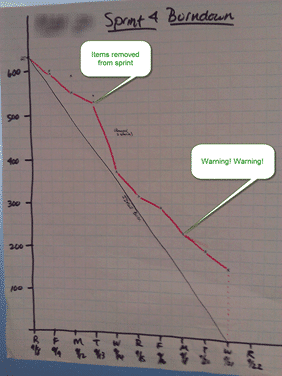
Figure: Not all early sprints will be successful
During a Scrum adoption expect to fail early and often. No, its more than that. I WANT to fail early and often as it is far less costly than the Waterfall (and and long iterative approach) where the risk is at the end and you fail late.
- Would you rather fail 4 agile projects at Sprint 4 or would you rather fail one waterfall in its 3rd year?
note: one is circa 20 times more expensive than the other… can you guess which?
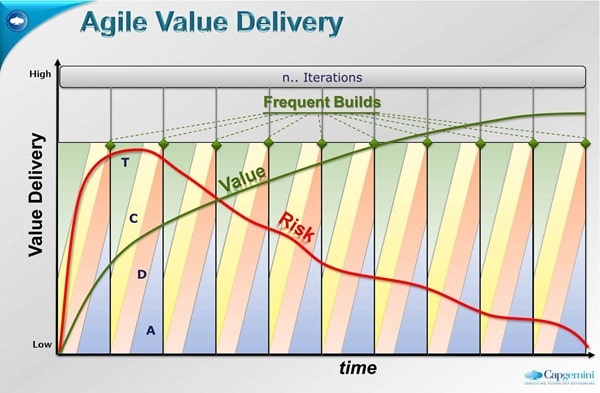
Figure: Agile risk is all up front
Remember it is HARD to do Scrum, your teams are not used to this process and your business is only beginning to understand the benefits. This is usually when IT management get cold feet and try to pull out. Remember that it is the Business that pays the bills and that they are usually on-board by now. The team may not have had a successful sprint but they will have been able to show “something” and the Product Owner will have been able to give feedback.
- How do you think the business will react if you suddenly take that feedback loop away from them?
Smart Classifications
Each classification [Concepts, Categories, & Tags] was assigned using AI-powered semantic analysis and scored across relevance, depth, and alignment. Final decisions? Still human. Always traceable. Hover to see how it applies.
What to read next
Professional Scrum Foundations in Alameda, California
Covers a two-day, hands-on Scrum.org course in Alameda, teaching Scrum principles, teamwork, and practical software delivery for all roles …
Why is Scrum so easy to understand but incredibly hard to master?
Explores why Scrum is challenging to master, highlighting cultural barriers, the importance of transparency, and the gap between …
Create your own path to Organisational Agility
Learn how to achieve organisational agility by tailoring change to your unique context, building a guiding coalition, and engaging all …
What is the hardest part of working with a brand-new scrum team?
The biggest challenge with new scrum teams is overcoming misconceptions about scrum and shifting focus from process mechanics to core agile …
Professional Scrum is for everyone in your organisation
Explains how involving everyone in Professional Scrum training fosters organisational agility, breaks down silos, and empowers teams to …
The Insufficiency of Scrum is a fallacy
Scrum alone does not cause project failure; lacking strong engineering practices and effective retrospectives leads to technical debt and …
Detecting agile theatre with real delivery signals
Why Most Companies Operating Models Fail in Dynamic Markets
A concise comparison of Predictive and Adaptive Operating Models, explaining why traditional structures fail in dynamic markets and how …
Don’t Manage Dependencies, Remove Them
Explains why dependencies are a sign of poor system design and outlines steps to eliminate them by aligning teams, clarifying ownership, and …
The Estimation Trap: How Tracking Accuracy Undermines Trust, Flow, and Value in Software Delivery
Tracking estimation accuracy in software delivery leads to mistrust, fear, and distorted behaviours. Focus on customer value, flow, and …
Flow of Value vs Flow of Work – Misnomer or Useful Shorthand?
Compares “flow of value” and “flow of work” in Kanban, explaining why only validated outcomes count as value and stressing the need for …
Why Outsourcing DevOps Fails, and How Real Engineering Excellence Starts With Your Team
Avoid DevOps vendor lock-in, discover how true engineering excellence starts with partnership, not outsourcing. Ready to transform your …
The Definition of Done is a Commitment to Quality
Defines the Definition of Done in Scrum as a clear, shared standard for quality, ensuring increments are releasable, transparent, and …
Why Your Definition of “Done” Is Holding Back Quality, Agility, and Trust, And How to Raise the Bar
Is your team’s “done” really done? Discover how a clear, objective definition of done boosts quality, agility, and trust in product …
Acceptance Criteria vs Definition of Done: Why Getting This Right Builds Trust and Delivers Quality Faster
Stop confusing acceptance criteria with definition of done, learn the crucial difference to boost quality, speed, and trust in your agile …
How to Evolve Your Definition of Done: Start Small, Grow Smarter, and Build Lasting Momentum
Unlock a smarter Definition of Done, start small, evolve standards, and build team momentum without overwhelm. Discover how progress drives …
Why Most Transformations Fail Without Honest Conversations
Most transformations fail without open, honest conversations that address real issues, making transparency and tough dialogue essential for …
Why Your Definition of Done Is the Secret Weapon for Real Business Impact and Agile Growth
Transform your definition of done into a strategic advantage, deliver real value, reduce risk, and drive business impact with every sprint.
Why Most Companies Operating Models Fail in Dynamic Markets
A concise comparison of Predictive and Adaptive Operating Models, explaining why traditional structures fail in dynamic markets and how …
The Estimation Trap: How Tracking Accuracy Undermines Trust, Flow, and Value in Software Delivery
Tracking estimation accuracy in software delivery leads to mistrust, fear, and distorted behaviours. Focus on customer value, flow, and …
Getting Started with Objectives & Key Results
Learn how to successfully implement OKRs by aligning clear strategy, fostering transparency, empowering teams, focusing on outcomes, and …
OKR Guide - A Social Discipline for Shared Focus, Measurable Contribution, and Strategic Learning
A certification proves you’ve passed a test
Certifications show test-passing ability but don’t prove real-world product skills. Experience, judgement, and stakeholder influence matter …
Most companies still get Product Ownership wrong
Many organisations misunderstand Product Ownership, treating it as simple backlog management instead of a strategic, accountable role …