In our Professional Agile Leadership training , we talk about changing your organisations hiring practices to hire more of the right sort of people to create the company that you want, not the company that you have. Hire the right people also implies that you will have to, within your cultural constraints, de-hire the wrong people.
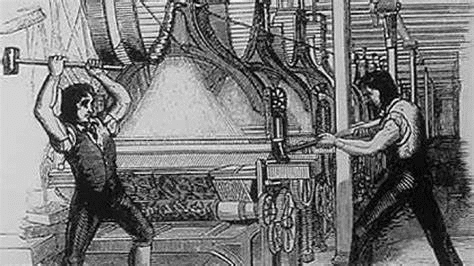
Early Luddites destroying machines during the industrial revolution
Luddite
“a person opposed to new technology or ways of working.”
“a small-minded Luddite resisting progress” · “I’m not a Luddite, after all I work with the internet for my job”
One of the reasons that your organisation is the way that it is, and that it is so hard to change, is its culture. The culture of an organisation is just a reflection of people that make up the organisation and the way that they do things.
As you transition from the traditional tayloristic model of departments and hierarchy to an empirical model of cross-functional delivery teams that suits the modern world of business you need to make sure that you have the right people or you will encounter friction at every turn. You may even find that some folks try to actively undermine the change.
“To be a leader in this company, your job is to find the rose petals in a field of shit.”
― Satya Nadella, Hit Refresh
These are the Luddites!
Luddites are an anchor to your nimbleness
As you move down your chosen agile evolutionary path there are many common changes that you will make, but there is a reason I use the phrase Evolution and not Transformation. An agile business is one that can adapt to changing circumstances effectively, quickly, and without panic, as the world changed around them.
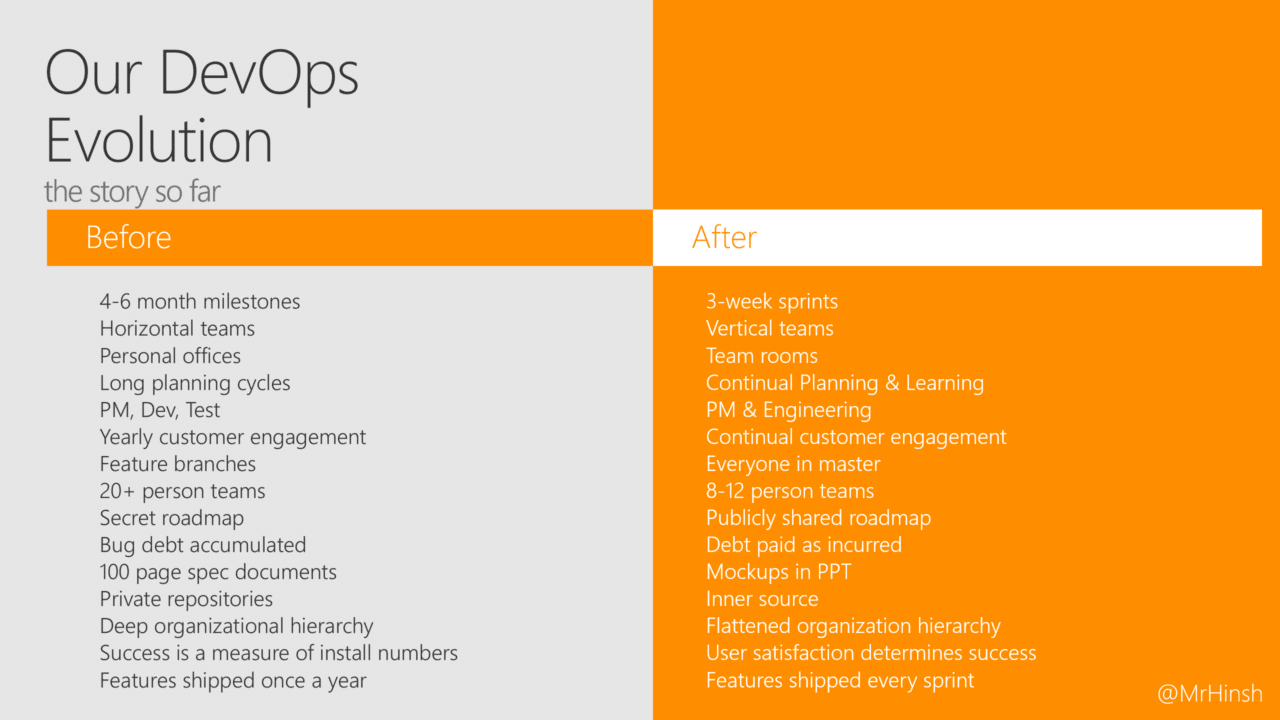
What changed at Microsoft as of 2017
Microsoft is the poster-child of what can be accomplished with the judicious application of leadership. With the servent-leadership and strategic vision of Satya Nadella, it has evolved from a traditional organisational model 10 years ago (2010) towards independent delivery teams of today.
“Every person, organization, and even society reaches a point at which they owe it to themselves to hit refresh, to reenergize, renew, reframe, and rethink their purpose.”
― Satya Nadella, Hit Refresh
If you go into Microsoft today and ask them what has changed since they were a traditional organisation, they will say “everything”! The list above is a point-in-time snapshot taken in 2017 from their evolution. Most things on that list have changed since then.
The world operates at a much higher frequency than it ever did before and a lack of learning, innovation, and evolution of our processes, practices, and tools is the realm of the Luddite.
Luddites have no place in the modern organisation #daretochange. Don’t be a Luddite!
Smart Classifications
Each classification [Concepts, Categories, & Tags] was assigned using AI-powered semantic analysis and scored across relevance, depth, and alignment. Final decisions? Still human. Always traceable. Hover to see how it applies.
What to read next
Evolution not Transformation: This is the Inevitability of change
Change in organisations is a continuous, evolutionary process driven by experimentation and adaptation, not a one-time transformation or …
The Race for Market Responsiveness: A Fresh Perspective on Organisational Agility
Explores why true organisational agility means building custom processes to respond quickly to market changes, not just adopting popular …
Embracing Change: Why Agile Evolution is the Key to Thriving in a Rapidly Shifting World
Explores why continuous organisational evolution, not fixed transformations, is essential for adapting to rapid change, fostering agility, …
Navigating Agile Transformation: Empowering Teams for Success in a Rapidly Changing Landscape
Explores effective Agile transformation by empowering teams, improving collaboration, focusing on value delivery, and fostering continuous …
Why is Satya Nadella a better example of agile leadership than Steve Jobs?
Compares Satya Nadella’s and Steve Jobs’s leadership, highlighting Nadella’s agile approach that fosters innovation, decentralised …
Empowering Leadership: Driving Cultural Change for Agile Success
Explores how effective leadership drives cultural change, supports agile practices, and fosters collaboration through vision, automation, …
Detecting agile theatre with real delivery signals
Why Most Companies Operating Models Fail in Dynamic Markets
A concise comparison of Predictive and Adaptive Operating Models, explaining why traditional structures fail in dynamic markets and how …
Don’t Manage Dependencies, Remove Them
Explains why dependencies are a sign of poor system design and outlines steps to eliminate them by aligning teams, clarifying ownership, and …
The Estimation Trap: How Tracking Accuracy Undermines Trust, Flow, and Value in Software Delivery
Tracking estimation accuracy in software delivery leads to mistrust, fear, and distorted behaviours. Focus on customer value, flow, and …
Flow of Value vs Flow of Work – Misnomer or Useful Shorthand?
Compares “flow of value” and “flow of work” in Kanban, explaining why only validated outcomes count as value and stressing the need for …
Why Outsourcing DevOps Fails, and How Real Engineering Excellence Starts With Your Team
Avoid DevOps vendor lock-in, discover how true engineering excellence starts with partnership, not outsourcing. Ready to transform your …
Why Most Companies Operating Models Fail in Dynamic Markets
A concise comparison of Predictive and Adaptive Operating Models, explaining why traditional structures fail in dynamic markets and how …
Getting Started with Objectives & Key Results
Learn how to successfully implement OKRs by aligning clear strategy, fostering transparency, empowering teams, focusing on outcomes, and …
Futureproof Leadership: How CTOs Can Cut Through the Noise and Lead with Clarity, Confidence, and Culture
Struggling with tech change? Discover how clarity, evidence, and culture can futureproof your team, no chasing trends, just smart …
From Burnout to Breakthrough: How CTOs Can Lead with Clarity, Resilience, and Real Innovation
Feeling overwhelmed as a tech leader? Discover how to shift from chaos to clarity and build resilient, future-ready teams, without burning …
Human and AI Agency in Adaptive Systems: Strategy Before Optimisation
Explores the distinct roles of human and AI agency in adaptive systems, emphasising human-led strategy and accountability versus AI-driven …
Stop Chasing Trends: How Real Agility and DevOps Build Resilient, Adaptable Teams
Stop chasing trends, build real agility. Discover how DevOps and agile create resilient teams, smoother delivery, and sustainable …