 No I am not leaving Northwest Cadence.
No I am not going to work at Microsoft… well I am, kind of. I have just started an engagement that will see me working as a Technical Product Manager as part of the Visual Studio Industry Partner Program.

An Orange badge (or “v dash” because of the v-username format) is an external vendor consulting inside of Microsoft. The Director of the VSIP team (Tom) has tagged me to help him better leveraging and understand the space between Microsoft Visual Studio Industry Partners and the Visual Studio product. This is an awesome opportunity to personally expand and allow the VSIP team to leverage my skills as an ALM Consultant, ALM MVP and ALM Ranger to the fullest to, hopefully, benefit both sides of this awesome sandwich.
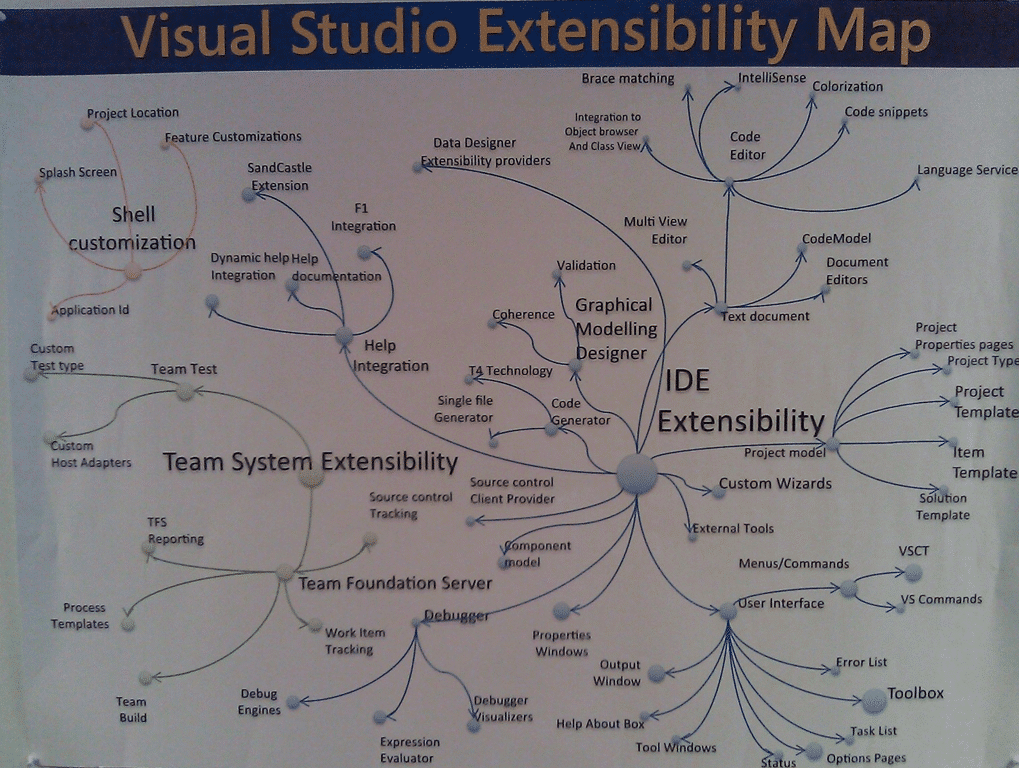
Figure: Visual Studio Extensibility Map
My key focus will be on:
-
Opportunities for partners to extend Visual Studio
There are many extensibility points in the Visual Studio stack from client to server and back again, but not all of them are being leveraged by the field. There are currently over 180+ VSIP members that are leveraging the benefits of a program designed to foster collaboration and growth of an ecosystem around Visual Studio and we want to grow that. In addition we need to understand where the partners fir, where they are going and what Microsoft can do to support them… a roadmap if you will. -
Opportunities for Visual Studio to be extended
There are many gaps in the extensibility that if this or that API was just tweaked a little we could get some awesome developer tools working. This is where I will be leasing heavily with the Product Teams for Visual Studio and Team Foundation Serve to make use that the extensibility points that the vendors want to leverage are up to par or even exist at all. This will enable Visual Studio to better support the partners and vice a versa.
My first task was defining a new taxonomy to fit out partners into as the old one was a little too low level with “ASP.NET” and “MVC” on the list. We went with parity to the general “Define”, ‘Develop” and “Operate” strategy that will help us better understand where the VSIP partners sit and where any gaps are.
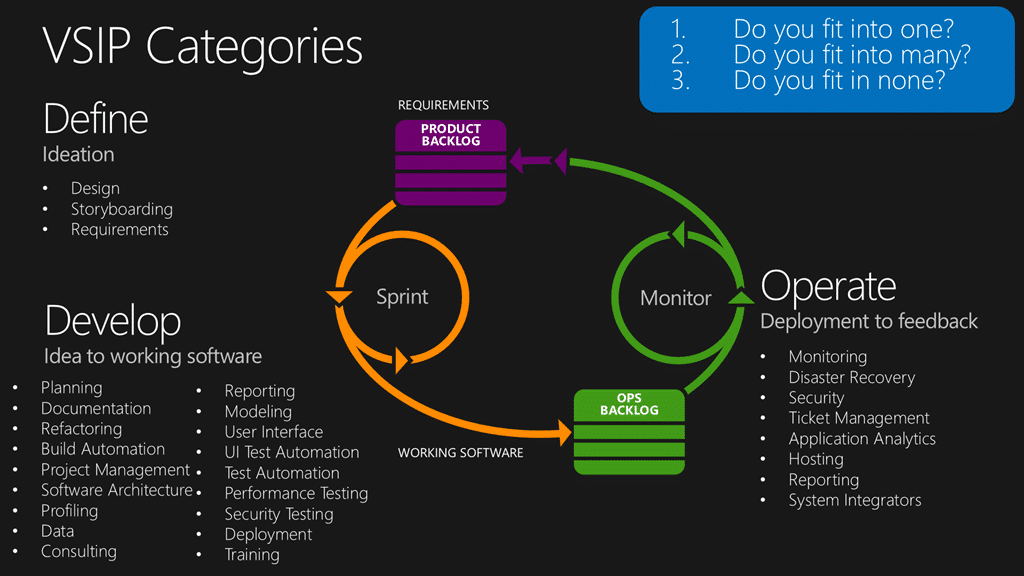
Figure: There are many places to integrate with Visual Studio
I am really exited about this not just as an opportunity to work more closely with the Product Team and get involved in the cool goings on in the vendor community, but also to grow as a consultant and take on new challenges. Over the last year and a half I have gone from being a Technical Consultant to a Process Consultant and Professional Scrum Trainer, and that is no easy transition while maintaining your technical competence. I do feel that some of my low level technical skills have dribbled out of my ears to make room for some of the other stuff, but hopefully not much.
Now adding to that the Product Management role which is very different from those that have gone before will be the next challenge. Also balancing that on a part time basis will be even more fun…
Do you integrate with Visual Studio? Did it fit into the new taxonomy?
What to read next
A change for the better #3 - SSW to Northwest Cadence
Reflects on lessons learned at SSW in software process, technology, and communication, and details a career move to an ALM consultant role …
A change for the better #2 - Aggreko to SSW
Describes a career move from Aggreko to SSW, focusing on software architecture, ALM, TFS migrations, and applying productivity rules in team …
A change for the better #4 - Homecoming
Details a move from the USA back to Scotland for family and education reasons, continuing ALM consulting, and plans to offer agile coaching …
ALM Consulting in Scotland, UK, Scandinavia & Europe
Provides ALM consulting, training, and assessments across Scotland, UK, and Europe, specialising in lean-agile, TFS, Visual Studio, Scrum, …
Detecting agile theatre with real delivery signals
Why Most Companies Operating Models Fail in Dynamic Markets
A concise comparison of Predictive and Adaptive Operating Models, explaining why traditional structures fail in dynamic markets and how …
Don’t Manage Dependencies, Remove Them
Explains why dependencies are a sign of poor system design and outlines steps to eliminate them by aligning teams, clarifying ownership, and …
The Estimation Trap: How Tracking Accuracy Undermines Trust, Flow, and Value in Software Delivery
Tracking estimation accuracy in software delivery leads to mistrust, fear, and distorted behaviours. Focus on customer value, flow, and …
Flow of Value vs Flow of Work – Misnomer or Useful Shorthand?
Compares “flow of value” and “flow of work” in Kanban, explaining why only validated outcomes count as value and stressing the need for …
Why Outsourcing DevOps Fails, and How Real Engineering Excellence Starts With Your Team
Avoid DevOps vendor lock-in, discover how true engineering excellence starts with partnership, not outsourcing. Ready to transform your …
Why Most Companies Operating Models Fail in Dynamic Markets
A concise comparison of Predictive and Adaptive Operating Models, explaining why traditional structures fail in dynamic markets and how …
The Estimation Trap: How Tracking Accuracy Undermines Trust, Flow, and Value in Software Delivery
Tracking estimation accuracy in software delivery leads to mistrust, fear, and distorted behaviours. Focus on customer value, flow, and …
Getting Started with Objectives & Key Results
Learn how to successfully implement OKRs by aligning clear strategy, fostering transparency, empowering teams, focusing on outcomes, and …
OKR Guide - A Social Discipline for Shared Focus, Measurable Contribution, and Strategic Learning
A certification proves you’ve passed a test
Certifications show test-passing ability but don’t prove real-world product skills. Experience, judgement, and stakeholder influence matter …
Most companies still get Product Ownership wrong
Many organisations misunderstand Product Ownership, treating it as simple backlog management instead of a strategic, accountable role …