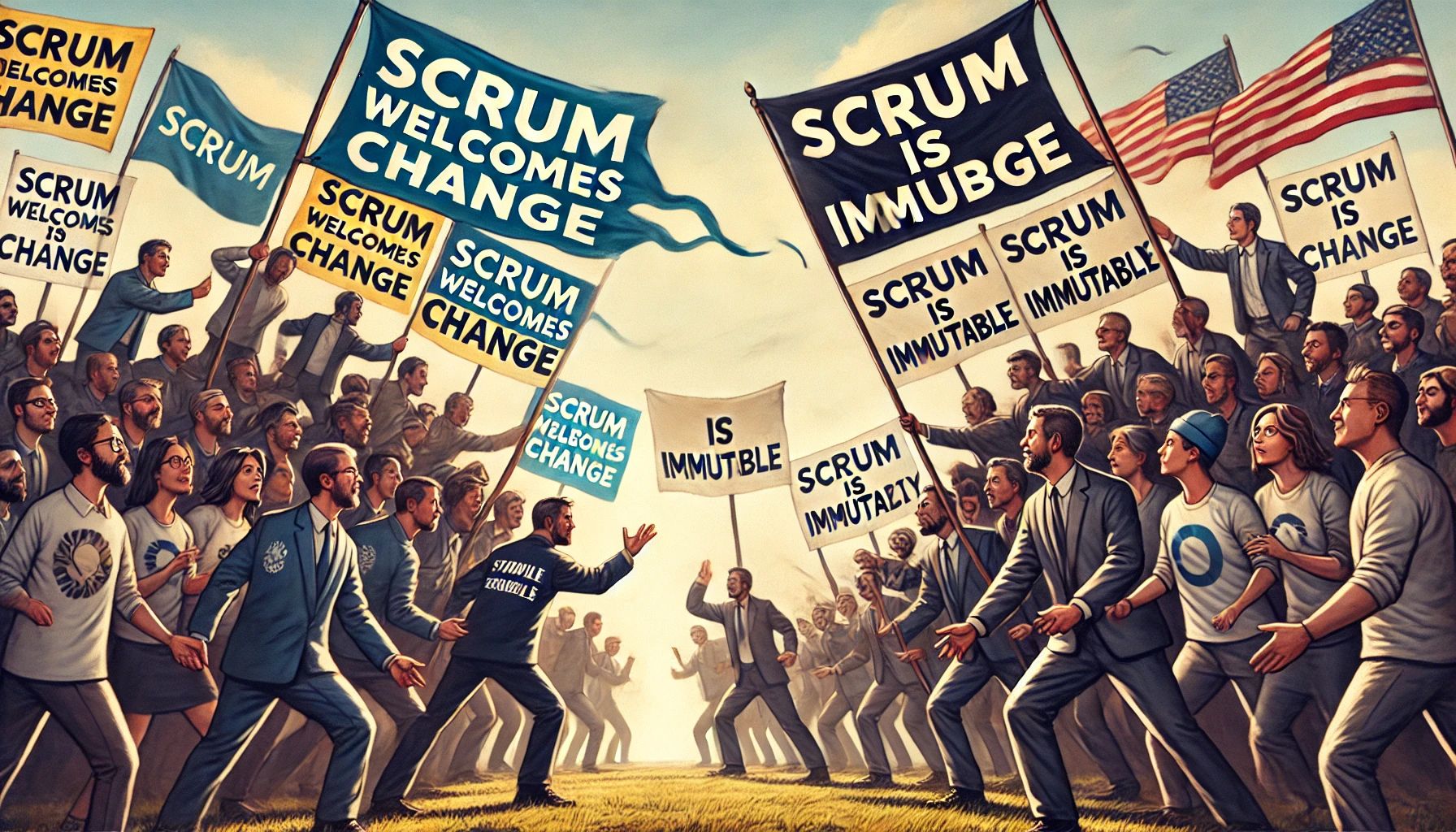
The false claim that “Scrum is immutable”!
The Scrum Guide makes it clear that it’s a flexible approach that welcomes change, including in Scrum itself, during implementation. Every part of the “Guide” (including its name) discusses flexibility and adaptation.
However, many will rally around the battle cry that “Scrum is immutable” and scream about its lack of fundamental agility, forgetting that it’s a “guide” and that its creators were one-sixth of those who created the Agile Manifesto.
The paragraph that they take offence to is way down in the “endnotes” of the Scrum Guide and reads:
“The Scrum framework, as outlined herein, is immutable. While implementing only parts of Scrum is possible, the result is not Scrum. Scrum exists only in its entirety and functions well as a container for other techniques, methodologies, and practices.”
I can kind of understand where the confusion comes from if one only reads the “The Scrum framework, as outlined herein, is immutable.” and ignores the rest. Still, with the content of the rest of the guide, as well as the following sentence, it is quite explicitly clear that this refers to an immutability of definition and not of implementation! This is an extremely important distinction that results in the idea that:
You don’t have to implement Scrum as it says in the Guide at all. You can do whatever you want.
All the Guide “asks” is that if we change the game’s core rules, we should be honest, open, and transparent and that we are playing a different game. Is that too difficult a concept to grasp?
The only people having these arguments are practitioners; for everyone else… it’s irrelevant. Focus instead on the intent and purpose…
…are we delivering value regularly? …are we getting feedback regularly? …are we adapting our plans regularly? …are we reflecting regularly?
Smart Classifications
Each classification [Concepts, Categories, & Tags] was assigned using AI-powered semantic analysis and scored across relevance, depth, and alignment. Final decisions? Still human. Always traceable. Hover to see how it applies.
What to read next
Scrum Myth Debunked: Unfinished Work is Allowed in Scrum
Clarifies Scrum guidelines on unfinished work, explaining that items can span multiple Sprints if the Sprint Goal and Done Increment remain …
Pragmatism crushes Dogma in the wild
Explores how practical use of Scrum fosters adaptability and resilience in teams, highlighting the value of flexibility over rigid rules in …
Best Scrum advice you ever received?
Emphasises the importance of flexibility and pragmatism in Scrum, encouraging teams to adapt frameworks to their context rather than rigidly …
Scrum isn’t limited to building features
Scrum can drive organisational change, not just product features, by using backlogs, teams, and feedback to enable real, evidence-based …
Companies often say "we-are going Agile!" as if declaring it makes it so
Many companies mistake adopting Agile frameworks for true agility, but real success comes from customising ways of working to respond …
Beyond the Rituals: Embracing the Core Principles of Scrum for True Agile Success
Explores how focusing on Scrum’s core principles, empiricism, transparency, and value delivery, leads to true agile success, beyond just …
Detecting agile theatre with real delivery signals
Why Most Companies Operating Models Fail in Dynamic Markets
A concise comparison of Predictive and Adaptive Operating Models, explaining why traditional structures fail in dynamic markets and how …
Don’t Manage Dependencies, Remove Them
Explains why dependencies are a sign of poor system design and outlines steps to eliminate them by aligning teams, clarifying ownership, and …
The Estimation Trap: How Tracking Accuracy Undermines Trust, Flow, and Value in Software Delivery
Tracking estimation accuracy in software delivery leads to mistrust, fear, and distorted behaviours. Focus on customer value, flow, and …
Flow of Value vs Flow of Work – Misnomer or Useful Shorthand?
Compares “flow of value” and “flow of work” in Kanban, explaining why only validated outcomes count as value and stressing the need for …
Why Outsourcing DevOps Fails, and How Real Engineering Excellence Starts With Your Team
Avoid DevOps vendor lock-in, discover how true engineering excellence starts with partnership, not outsourcing. Ready to transform your …
The Definition of Done is a Commitment to Quality
Defines the Definition of Done in Scrum as a clear, shared standard for quality, ensuring increments are releasable, transparent, and …
Why Your Definition of “Done” Is Holding Back Quality, Agility, and Trust, And How to Raise the Bar
Is your team’s “done” really done? Discover how a clear, objective definition of done boosts quality, agility, and trust in product …
Acceptance Criteria vs Definition of Done: Why Getting This Right Builds Trust and Delivers Quality Faster
Stop confusing acceptance criteria with definition of done, learn the crucial difference to boost quality, speed, and trust in your agile …
How to Evolve Your Definition of Done: Start Small, Grow Smarter, and Build Lasting Momentum
Unlock a smarter Definition of Done, start small, evolve standards, and build team momentum without overwhelm. Discover how progress drives …
Why Most Transformations Fail Without Honest Conversations
Most transformations fail without open, honest conversations that address real issues, making transparency and tough dialogue essential for …
Why Your Definition of Done Is the Secret Weapon for Real Business Impact and Agile Growth
Transform your definition of done into a strategic advantage, deliver real value, reduce risk, and drive business impact with every sprint.
Why Most Companies Operating Models Fail in Dynamic Markets
A concise comparison of Predictive and Adaptive Operating Models, explaining why traditional structures fail in dynamic markets and how …
Don’t Manage Dependencies, Remove Them
Explains why dependencies are a sign of poor system design and outlines steps to eliminate them by aligning teams, clarifying ownership, and …
The Estimation Trap: How Tracking Accuracy Undermines Trust, Flow, and Value in Software Delivery
Tracking estimation accuracy in software delivery leads to mistrust, fear, and distorted behaviours. Focus on customer value, flow, and …
Kendall Guide - A System of Work for AI Adoption
Flow of Value vs Flow of Work – Misnomer or Useful Shorthand?
Compares “flow of value” and “flow of work” in Kanban, explaining why only validated outcomes count as value and stressing the need for …
Estimating Better in an Overloaded System Is a Poor Man’s Strategy
High work in progress (WIP) causes delays and unpredictability; improving estimates won’t help. Limiting WIP and focusing on flow is key to …