I was recently in Park City, Utah to teach the Professional Scrum Foundations course and i just got an email from one of the students. As I want to help everyone I will answer here:
If I recall from our training, you suggested teams could burn down their sprints using points or hours. In your view is there a “better” answer in your opinion (pros/cons)?
-Pete
The first thing that we want to do is define explicitly what a burndown represents and the reason that we are creating one; i.e. what actions might we want to take. Only then can we decide what we want to measure and which is best for us.
What is a burndown?
During Sprint Planning the Development Team forecast what work it thinks it could do (selected a number of PBI’s from the Product Backlog) and created a Plan to complete them. This is known as the Sprint Backlog and it should have some measure of Remaining Work that allows the Development Team to see what they have left to do. As the Sprint Backlog (the Plan to complete the forecast PBI’s) evolves as more is known over the course of the Sprint the Remaining Work can vary and we need a way of visualizing trends so that the Development Team can take the necessary action.
A burndown is a visual representation of the Remaining Work in the Sprint Backlog as it varies over time.
What might we find?
So in order to identify actions we need to look at some things we might identify as a problem.
-
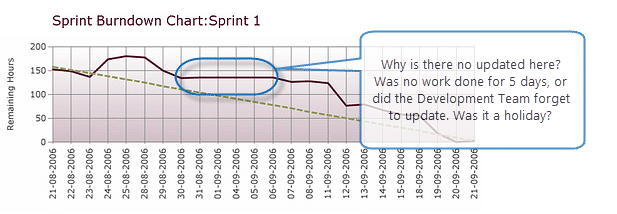
We get a flat burndown
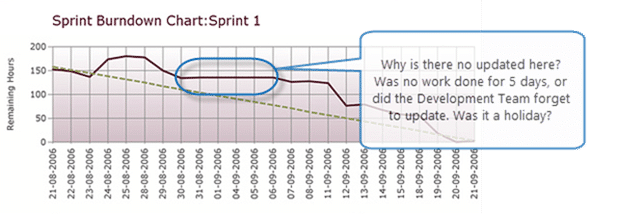
Figure: What does a flat burndown mean? This might be because we just forgot, or it might be representative of a tooling issue or even a team issue that exists.
- Action: Update our Remaining Work - Action: Get better at filling it out in time for the Daily Scrum - Action: Raise an impediment to the Scrum Master to improve the tools - Action: Raise an impediment to the Scrum Master to help the Development Team improve -
We get a perfect burndown, but delivered nothing
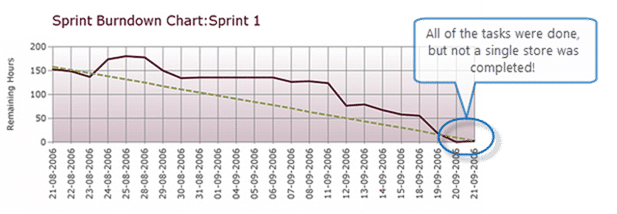
Figure: All of the Tasks were complete This is likely to be because we have too much work in progress at any one time. We have 10 Stories in progress and get to the end of the Sprint with all of our Stories 90% complete.
- Action: Raise an impediment with the Scrum Master for review at the Retrospective - Action: Limit work in progress _"Given an ordered list of user stories, **you’re either working on the top item, or else you’d better have a good reason not to**. You don’t proceed with another story until your current story is done." _\-[The Task Burn Down Trap: everything finished, nothing done](http://blog.xebia.com/2008/09/19/the-task-burn-down-trap-everything-finished-nothing-done/) -
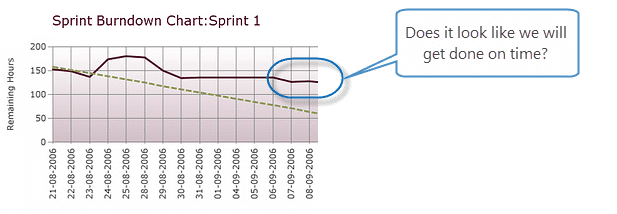
We will not get done on time
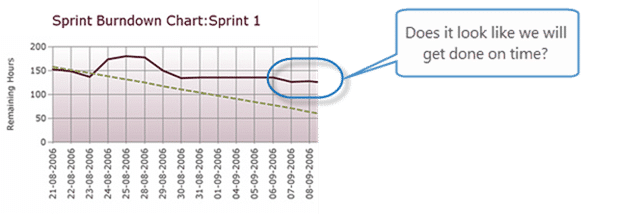
Figure: When will we be done? This can be because we do not know everything at the start of the Sprint. Can a lawyer tell you exactly how long your case will take and what it will cost? No, so why would you expect something like software to?
- Action: Speak to the Product Owner and decide what can be removed from the Sprint Backlog to still allow the team to be done.

These are just some ideas of what might be found and are not indicative of all possible options and there are other lists of Bad Smells of the Sprint Backlog that you can find online.
Let me reiterate, that along with the Three Questions that are part of the Daily Scrum a Burndown is just a tool to help elicit communication and understanding within the Development Team. It is not a whip for a Project Manager to crack.
What burndown is right?
So to answer the question of wither to burn down Story Points, Hours or even Test Cases I would argue that we need them all! I want to see if my tasks are on track, but I also want to make sure that I am delivering Stories as well.
The Hours Burndown
This burndown is good for helping the Development Team identify how much work is remaining in the Sprint and if they are likely to still be able to meet their Sprint Goal.
The Story Point Burndown
Good for allowing the Development Team to see if they are actually getting things Done, verses completing all of the Tasks.
The Acceptance Tests Burndown
Also a good indicator of what is going on from a delivery perspective. If you are on track for Hours, and Story Points but you have only completed 50% of your Acceptance Tests and you have 2 days left on your Sprint, what does that tell you about your quality.
Conclusion
You will need to experiment with your Scrum Teams to see which burndown is right for you, but I would suggest that you want to be able to plot all of them so that your Development Team’s have all of the relevant information for their Daily Scrum to help them identify any issues as early as possible.
Smart Classifications
Each classification [Concepts, Categories, & Tags] was assigned using AI-powered semantic analysis and scored across relevance, depth, and alignment. Final decisions? Still human. Always traceable. Hover to see how it applies.
What to read next
My first Scrum team in the wild
A real-world account of guiding a new Scrum team through their first sprint, covering estimation, story points, sprint planning, and …
The Ghosts of Agile Past: Why Burndown Charts Might Be Holding You Back
Explores why burndown charts can limit Agile teams, highlighting the drawbacks of fixed planning and advocating for adaptability, empirical …
The Pitfalls of Agile Burndowns: Stop Being Agile Bandits
Explains why relying on Agile burndown charts leads to over-planning and false progress, and advocates for minimal, adaptive planning and …
Story Points & Velocity are a sign of an unsuccessful team
Explains why relying on story points and velocity signals team immaturity in Scrum, and highlights better ways to build confidence and …
Story Points: A Ghost of Agile Past
Explores the problems with story points in Agile, their impact on team behaviour, and why flow metrics offer a better way to measure …
Rethinking Sprint Planning: Why Burndown Charts Are Agile Banditry and What to Do Instead
Explains why burndown charts hinder agile teams, highlighting the pitfalls of detailed upfront planning and advocating for minimal, adaptive …
Detecting agile theatre with real delivery signals
Why Most Companies Operating Models Fail in Dynamic Markets
A concise comparison of Predictive and Adaptive Operating Models, explaining why traditional structures fail in dynamic markets and how …
Don’t Manage Dependencies, Remove Them
Explains why dependencies are a sign of poor system design and outlines steps to eliminate them by aligning teams, clarifying ownership, and …
The Estimation Trap: How Tracking Accuracy Undermines Trust, Flow, and Value in Software Delivery
Tracking estimation accuracy in software delivery leads to mistrust, fear, and distorted behaviours. Focus on customer value, flow, and …
Flow of Value vs Flow of Work – Misnomer or Useful Shorthand?
Compares “flow of value” and “flow of work” in Kanban, explaining why only validated outcomes count as value and stressing the need for …
Why Outsourcing DevOps Fails, and How Real Engineering Excellence Starts With Your Team
Avoid DevOps vendor lock-in, discover how true engineering excellence starts with partnership, not outsourcing. Ready to transform your …
The Definition of Done is a Commitment to Quality
Defines the Definition of Done in Scrum as a clear, shared standard for quality, ensuring increments are releasable, transparent, and …
Why Your Definition of “Done” Is Holding Back Quality, Agility, and Trust, And How to Raise the Bar
Is your team’s “done” really done? Discover how a clear, objective definition of done boosts quality, agility, and trust in product …
Acceptance Criteria vs Definition of Done: Why Getting This Right Builds Trust and Delivers Quality Faster
Stop confusing acceptance criteria with definition of done, learn the crucial difference to boost quality, speed, and trust in your agile …
How to Evolve Your Definition of Done: Start Small, Grow Smarter, and Build Lasting Momentum
Unlock a smarter Definition of Done, start small, evolve standards, and build team momentum without overwhelm. Discover how progress drives …
Why Most Transformations Fail Without Honest Conversations
Most transformations fail without open, honest conversations that address real issues, making transparency and tough dialogue essential for …
Why Your Definition of Done Is the Secret Weapon for Real Business Impact and Agile Growth
Transform your definition of done into a strategic advantage, deliver real value, reduce risk, and drive business impact with every sprint.