It has been 25 years since Scrum was first created by Ken Schwaber and Jeff Sutherland and it has gone through many revisions. The last major revision was in 2017 and this update represents a simplification for 2020.
New updates include simplified language, less prescriptive and emphasis on the Scrum Team and its need to be self-managing
It’s very clear that Scrum has not changed! Ken & Jeff have just found better ways to describe Scrum to simplify the story as well as reduce the cognitive load of interpreting it.
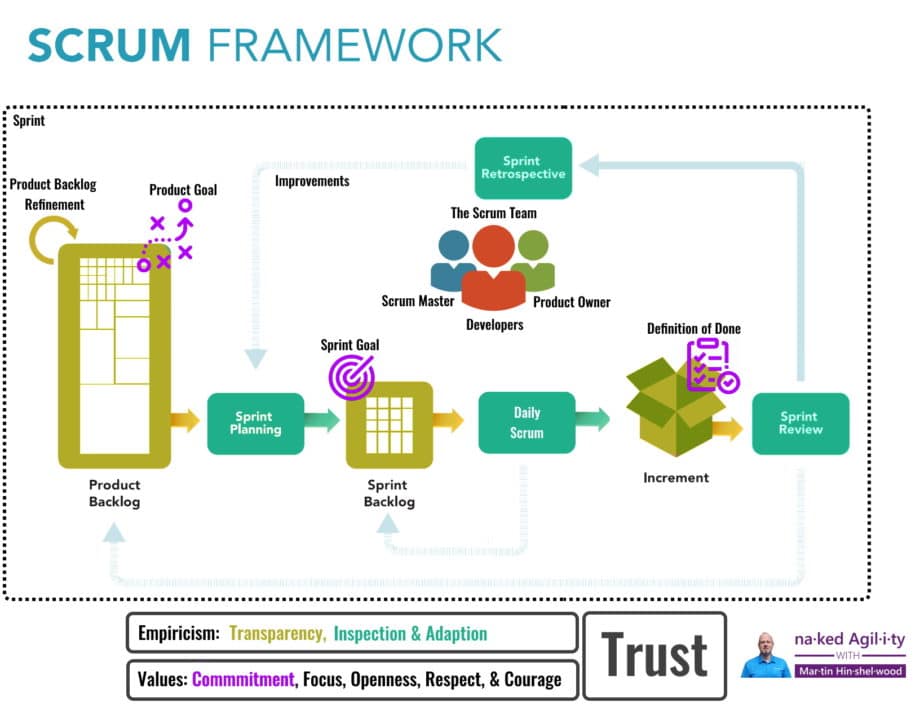
There are lots of awesome changes so let’s see if I can highlight the things I noticed the most:
- Scrum Teams are self-managing - Scrum Teams are cross-functional, meaning the members have all the skills necessary to create value each Sprint. They are also self-managing, meaning they internally decide who does what, when, and how.
- Scrum Team is accountable for creating a valuable - The entire Scrum Team is accountable for creating a valuable, useful Increment every Sprint. Scrum defines three specific accountabilities within the Scrum Team: the Developers, the Product Owner, and the Scrum Master.
- The Product Goal is a commitment for the Product Backlog - The Product Goal describes a future state of the product which can serve as a target for the Scrum Team to plan against. The Product Goal is in the Product Backlog. The rest of the Product Backlog emerges to define “what” will fulfill the Product Goal.
- The Sprint Goal is a commitment for the Sprint Backlog - The Sprint Goal is the single objective for the Sprint. Although the Sprint Goal is a commitment by the Developers, it provides flexibility in terms of the exact work needed to achieve it. The Sprint Goal also creates coherence and focus, encouraging the Scrum Team to work together rather than on separate initiatives.
- Definition of Done is a commitment for the Increment - The Definition of Done is a formal description of the state of the Increment when it meets the quality measures required for the product. The moment a Product Backlog item meets the Definition of Done, an Increment is born.
- The What, the Why, and the How of Sprint Planning - The Product Owner ensures that attendees are prepared to discuss the most important Product Backlog items and how they map to the Product Goal. The Scrum Team may also invite other people to attend Sprint Planning to provide advice.
I hope that that get as much from this new revision of the Scrum Guide as I have.
Get your copy of the new version of the Scrum Guide !
Smart Classifications
Each classification [Concepts, Categories, & Tags] was assigned using AI-powered semantic analysis and scored across relevance, depth, and alignment. Final decisions? Still human. Always traceable. Hover to see how it applies.
What to read next
Are you doing Scrum? Really?
Explains recent changes to Scrum aimed at reducing rigidity, clarifying core practices, and providing a checklist to help teams assess if …
Unlocking Scrum Success: A Comprehensive Guide to Values, Roles, Artifacts, and Events
Explains Scrum’s core values, roles, artifacts, and events, highlighting how they support teamwork, transparency, and adaptability in …
Pragmatism crushes Dogma in the wild
Explores how practical use of Scrum fosters adaptability and resilience in teams, highlighting the value of flexibility over rigid rules in …
How do you think Agile is evolving since its inception in 2001?
Explores how Agile has shifted from top-down management to decentralised decision-making, highlighting ongoing challenges and the move …
Best Scrum advice you ever received?
Emphasises the importance of flexibility and pragmatism in Scrum, encouraging teams to adapt frameworks to their context rather than rigidly …
Detecting agile theatre with real delivery signals
Why Most Companies Operating Models Fail in Dynamic Markets
A concise comparison of Predictive and Adaptive Operating Models, explaining why traditional structures fail in dynamic markets and how …
Don’t Manage Dependencies, Remove Them
Explains why dependencies are a sign of poor system design and outlines steps to eliminate them by aligning teams, clarifying ownership, and …
The Estimation Trap: How Tracking Accuracy Undermines Trust, Flow, and Value in Software Delivery
Tracking estimation accuracy in software delivery leads to mistrust, fear, and distorted behaviours. Focus on customer value, flow, and …
Flow of Value vs Flow of Work – Misnomer or Useful Shorthand?
Compares “flow of value” and “flow of work” in Kanban, explaining why only validated outcomes count as value and stressing the need for …
Why Outsourcing DevOps Fails, and How Real Engineering Excellence Starts With Your Team
Avoid DevOps vendor lock-in, discover how true engineering excellence starts with partnership, not outsourcing. Ready to transform your …
The Definition of Done is a Commitment to Quality
Defines the Definition of Done in Scrum as a clear, shared standard for quality, ensuring increments are releasable, transparent, and …
Why Your Definition of “Done” Is Holding Back Quality, Agility, and Trust, And How to Raise the Bar
Is your team’s “done” really done? Discover how a clear, objective definition of done boosts quality, agility, and trust in product …
Acceptance Criteria vs Definition of Done: Why Getting This Right Builds Trust and Delivers Quality Faster
Stop confusing acceptance criteria with definition of done, learn the crucial difference to boost quality, speed, and trust in your agile …
How to Evolve Your Definition of Done: Start Small, Grow Smarter, and Build Lasting Momentum
Unlock a smarter Definition of Done, start small, evolve standards, and build team momentum without overwhelm. Discover how progress drives …
Why Most Transformations Fail Without Honest Conversations
Most transformations fail without open, honest conversations that address real issues, making transparency and tough dialogue essential for …
Why Your Definition of Done Is the Secret Weapon for Real Business Impact and Agile Growth
Transform your definition of done into a strategic advantage, deliver real value, reduce risk, and drive business impact with every sprint.
Why Most Companies Operating Models Fail in Dynamic Markets
A concise comparison of Predictive and Adaptive Operating Models, explaining why traditional structures fail in dynamic markets and how …
Don’t Manage Dependencies, Remove Them
Explains why dependencies are a sign of poor system design and outlines steps to eliminate them by aligning teams, clarifying ownership, and …
The Estimation Trap: How Tracking Accuracy Undermines Trust, Flow, and Value in Software Delivery
Tracking estimation accuracy in software delivery leads to mistrust, fear, and distorted behaviours. Focus on customer value, flow, and …
Kendall Guide - A System of Work for AI Adoption
Flow of Value vs Flow of Work – Misnomer or Useful Shorthand?
Compares “flow of value” and “flow of work” in Kanban, explaining why only validated outcomes count as value and stressing the need for …
Estimating Better in an Overloaded System Is a Poor Man’s Strategy
High work in progress (WIP) causes delays and unpredictability; improving estimates won’t help. Limiting WIP and focusing on flow is key to …