 Since I have joined SSW as a Solution Architect its Chief Architect, Adam Cogan, has been mentoring me and pushing me to do better. One of the things that I have been wanting to do since the first DDD Scotland was to present a session. For DDD Scotland 2010 Adam suggested that I submit he double session on “Better project Management with Team Foundation Server 2010”.
So, with some apprehension I submitted two session as Part A and Part B.
Download DDD Scotland - Scrum with Team Foundation Server 2010
How surprised was I that after the attendees had finished casting their votes that both sessions would be in the top 20 one in the top 5. I an effort to promote diversity in sessions the DDD committee try to make sure that each presenter only have one session. I would have to compress SSW’s presentation into 1 hour.
Around this time SSW embarked on it continuing adventures with scrum an Microsoft started heavily investing in Scrum for its internal use. I decided to do a slightly different session, but one that would still meet the agenda and goal of the billed session to provide “Better project management with Team Foundation Server 2010”.
And so Scrum with Team Foundation Server 2010 was born. At this stage I really have to thank Aaron Bjork who provided me with many of the slides and animations as I really can’t work Power Point.
On the 27th of April I presented the session for the Aberdeen Partner Group and then on 8th May I presented at DDD Scotland .
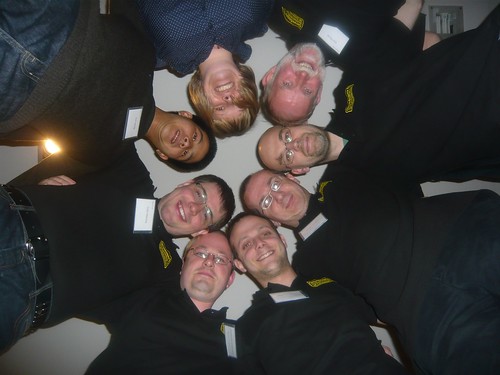
Figure: Some of the presenters and organisers of DDD Scotland
I mentioned quite a few of SSW’s Rules to better Scrum Using TFS and I have uploaded my presentation to Skydrive.
Download DDD Scotland - Scrum with Team Foundation Server 2010
Technorati Tags: Scrum TFS 2010 ALM DDD Scot Live SSW SP 2010 SharePoint
Smart Classifications
Each classification [Concepts, Categories, & Tags] was assigned using AI-powered semantic analysis and scored across relevance, depth, and alignment. Final decisions? Still human. Always traceable. Hover to see how it applies.
What to read next
Scrum for Team Foundation Server 2010
Learn how to implement Scrum practices using Team Foundation Server 2010 and Visual Studio ALM, including project planning, backlog …
Developer Day Scotland
Summary of sessions from a Glasgow developer event, covering refactoring, dynamic languages in .NET, MVVM for WPF, architecture, and ASP.NET …
NDC London 2014: Why TFS no longer sucks and VSO is awesome
Overview of improvements in Team Foundation Server (TFS) and Visual Studio Online (VSO), including updated features, cloud integration, and …
Professional Scrum Developer (.NET) Training in London
Intensive five-day course for software developers covering Scrum, Visual Studio 2010, .NET, and Agile practices through hands-on team …
Post event: Developer Day Scotland
Highlights from Developer Day Scotland, featuring sessions on ADO.NET Data Services, anti-patterns, continuous integration, and test-driven …
Detecting agile theatre with real delivery signals
Why Most Companies Operating Models Fail in Dynamic Markets
A concise comparison of Predictive and Adaptive Operating Models, explaining why traditional structures fail in dynamic markets and how …
Don’t Manage Dependencies, Remove Them
Explains why dependencies are a sign of poor system design and outlines steps to eliminate them by aligning teams, clarifying ownership, and …
The Estimation Trap: How Tracking Accuracy Undermines Trust, Flow, and Value in Software Delivery
Tracking estimation accuracy in software delivery leads to mistrust, fear, and distorted behaviours. Focus on customer value, flow, and …
Flow of Value vs Flow of Work – Misnomer or Useful Shorthand?
Compares “flow of value” and “flow of work” in Kanban, explaining why only validated outcomes count as value and stressing the need for …
Why Outsourcing DevOps Fails, and How Real Engineering Excellence Starts With Your Team
Avoid DevOps vendor lock-in, discover how true engineering excellence starts with partnership, not outsourcing. Ready to transform your …
The Definition of Done is a Commitment to Quality
Defines the Definition of Done in Scrum as a clear, shared standard for quality, ensuring increments are releasable, transparent, and …
Why Your Definition of “Done” Is Holding Back Quality, Agility, and Trust, And How to Raise the Bar
Is your team’s “done” really done? Discover how a clear, objective definition of done boosts quality, agility, and trust in product …
Acceptance Criteria vs Definition of Done: Why Getting This Right Builds Trust and Delivers Quality Faster
Stop confusing acceptance criteria with definition of done, learn the crucial difference to boost quality, speed, and trust in your agile …
How to Evolve Your Definition of Done: Start Small, Grow Smarter, and Build Lasting Momentum
Unlock a smarter Definition of Done, start small, evolve standards, and build team momentum without overwhelm. Discover how progress drives …
Why Most Transformations Fail Without Honest Conversations
Most transformations fail without open, honest conversations that address real issues, making transparency and tough dialogue essential for …
Why Your Definition of Done Is the Secret Weapon for Real Business Impact and Agile Growth
Transform your definition of done into a strategic advantage, deliver real value, reduce risk, and drive business impact with every sprint.