You need quality enablement to achieve predictable delivery for your organisation which takes effort to achieve.
I do a lot of ALM Assessments for companies and almost every customer that I speak to has unpredictable quality in the software delivery that they receive from their teams. This is not always the Development Teams fault and is often the result of an organisation that is finely tuned to minimise the ability to have a defined and predictable level of quality. In most cases this is due to a lack of a bar that quantifies the minimum things that need to be completed in order for and organisation to understand what i involved in each delivery.
If you have no bar for delivery and thus no idea what needs to be completed for each thing to be delivered then how can you expect to make accurate (or at least as good as we can get) prediction on when things are going to be delivered? You would effectively have no empirical evidence to rely on for predictability of delivery. In addition, the varied quality level results in more bugs in production, which then puts those individuals’ responsible for adding features under more pressure. If you put developers under pressure they will consistently and increasingly cut quality to meet the same deliverable.
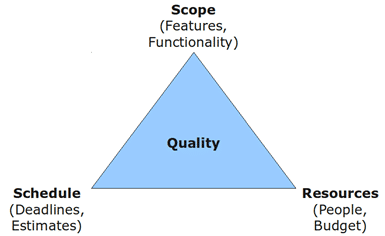
Figure: The Iron Triangle
In addition many product backlogs lack acceptance criteria leaving the Development Team to guess at the basis by which the customer will accept that something is complete. Indeed because if this lack of acceptance criteria backlog items can often be deceptively large which puts the development team under greater pleasure for delivery and thus the cut quality.
Fix quality for improved predictability
The only way to successfully create predictable software delivery is to fix 3 of the 4 points of the Iron Triangle. In traditional software development quality is the hidden value and if you fix everything else it is Quality that suffers. Quality should be anchored with an explicit definition.
- Definition of Done – Your DoD is the fixed measure or explicit definition of quality for your software development process. It is a short measurable checklist which mirrors shippable that can and is applied to every unit of work delivered. It can be hard to define but without it we don’t know how much work needs to be done in order to ship any backlog item. Apply it at least to the output of the iteration and ideally to every backlog item that you complete.
- Acceptance Criteria – While the DoD is applied equally to every backlog item acceptance criteria only applies to an individual item. All conversations between the Development Team, Product Owner and the Business should be reflected in the acceptance criteria so that things that are discussed are mot missed. This also serves to understand scale and encourages breaking down backlog items into smaller units of work. Once you understand what needs to be done to complete an item, overly large items become transparently obvious.
- Automated Builds – Having automated builds that can measure the quality of your software is paramount to minimising the amount of work that the team needs to do to verify the software and creating automated acceptance tests and unit tests increase the validity of those builds. Ideally you should have an automated test (UI or Unit) for every acceptance criteria that was added to the backlog item.
- Automated Deployment – Having automated deployment will force the team to create working software and allow you to build and maintain something that will minimize the cost of delivery. If the Development Team knows that the business can choose to ship at any time they are then under pressure to maintain that ship-ability and thus quality.
Doing all of these things will serve to make quality the goal not the lack of it.
Conclusion
The way that we have traditionally measured our development teams have finely tuned them to fluctuate quality in order to meet aggressive delivery schedules. However this fluctuating quality only serves to reduce our ability to deliver and annoy our customers when they find the resulting bugs.
The goal is to increase quality not reduce it but first we need to be able to measure that quality and enforce it.
Smart Classifications
Each classification [Concepts, Categories, & Tags] was assigned using AI-powered semantic analysis and scored across relevance, depth, and alignment. Final decisions? Still human. Always traceable. Hover to see how it applies.
What to read next
Release planning and predictable delivery
Explores how agile teams can achieve predictable software delivery through quality focus, effective release planning, and continuous …
Professional Scrum teams build software that works
Professional Scrum Teams prioritise software quality, accountability, and continuous improvement, ensuring each release is reliable, …
Quality enablement with Visual Studio 2012
Explores how Visual Studio 2012 supports continuous quality enablement, automated testing, and rapid delivery in modern software development …
Why a Shared Definition of Done Is the Secret to Consistent, Predictable Quality in Agile Teams
Struggling with inconsistent delivery? Discover why a shared definition of done is key to predictable, high-quality results your teams, and …
Stop Hoping for Quality: Why Automated Pipelines Are the Only Way to Deliver with Confidence
Stop relying on memory for quality. Discover why automated pipelines beat manual checks, and how embedding quality gates ensures trust, …
Why compromising on software quality is a leadership decision
Compromising software quality is a leadership choice, not a team one. Lowering standards carries business risks that should be openly …
Detecting agile theatre with real delivery signals
Why Most Companies Operating Models Fail in Dynamic Markets
A concise comparison of Predictive and Adaptive Operating Models, explaining why traditional structures fail in dynamic markets and how …
Don’t Manage Dependencies, Remove Them
Explains why dependencies are a sign of poor system design and outlines steps to eliminate them by aligning teams, clarifying ownership, and …
The Estimation Trap: How Tracking Accuracy Undermines Trust, Flow, and Value in Software Delivery
Tracking estimation accuracy in software delivery leads to mistrust, fear, and distorted behaviours. Focus on customer value, flow, and …
Flow of Value vs Flow of Work – Misnomer or Useful Shorthand?
Compares “flow of value” and “flow of work” in Kanban, explaining why only validated outcomes count as value and stressing the need for …
Why Outsourcing DevOps Fails, and How Real Engineering Excellence Starts With Your Team
Avoid DevOps vendor lock-in, discover how true engineering excellence starts with partnership, not outsourcing. Ready to transform your …
Detecting agile theatre with real delivery signals
Don’t Manage Dependencies, Remove Them
Explains why dependencies are a sign of poor system design and outlines steps to eliminate them by aligning teams, clarifying ownership, and …
The Estimation Trap: How Tracking Accuracy Undermines Trust, Flow, and Value in Software Delivery
Tracking estimation accuracy in software delivery leads to mistrust, fear, and distorted behaviours. Focus on customer value, flow, and …
Flow of Value vs Flow of Work – Misnomer or Useful Shorthand?
Compares “flow of value” and “flow of work” in Kanban, explaining why only validated outcomes count as value and stressing the need for …
Why Outsourcing DevOps Fails, and How Real Engineering Excellence Starts With Your Team
Avoid DevOps vendor lock-in, discover how true engineering excellence starts with partnership, not outsourcing. Ready to transform your …
Estimating Better in an Overloaded System Is a Poor Man’s Strategy
High work in progress (WIP) causes delays and unpredictability; improving estimates won’t help. Limiting WIP and focusing on flow is key to …