These Sirens take advantage of the lack of understanding of what business agility is trying to change and lures unsuspecting C-suite executives into parting with their cash for what is effectively someone else’s business process. They are changing their entire organisation, not because of a business challenge, but because they are told to.

The Siren song of SAFe
The lure is strong! They can spend a few million dollars and pow, their organisation is agile, and our business is saved. They make sweeping changes to their lexicon and organisations of their business. We have installed agility!

SAFe is a fictitious beast that looks cute, but is really dangerous and deadly.
I’m not saying that SAFe did not work, or that some organisations don’t get value from it. Just like traditional tayloristic practices, many organisations were able to thrive in spite of the choices that they made.
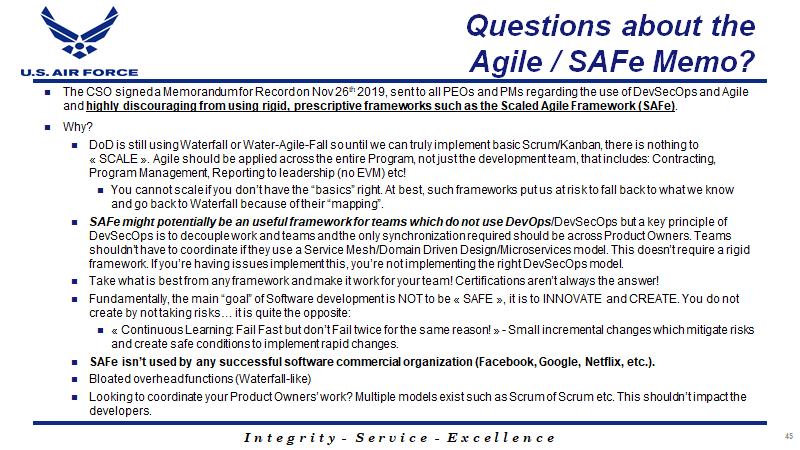
Even the US Airforce thinks of SAFE as rigid and prescriptive framework
Many large organisations are waking up to this reality and are evolving instead of transforming. Transformation implies an end, a final stage, and the reality of today’s businesses is that nothing stays still for long.
Organisations have a lot in common with the animal kingdom. Animals evolve to fill a niche and thrive until that niche changes and they can either evolve again or die. In the past evolution of companies and the changing ecosystem of niches were slow, giving even the largest organisations time to adapt. However, those days are gone now.
The world is changing faster and faster and your organisation needs to embrace evolution. You need to be able to change to take advantage of new business opportunities as they arise and to do that you need a level of business agility that may astound you.
Fundamentally, the main “goal” of Software development is NOT to be « SAFE », it is to INNOVATE and CREATE. You do not create by not taking risks…
Scaled Agile Framework is just Taylorism with an Agile lexicon
I talk often of the tyranny of Taylorism and the rigidity that it has instilled over many generations and constant bombardment of this is the way this should be done. This rigidity of the “best practice” or “we always do it that way”, or “we can’t do that here” is a symptom of that old thinking that was designed to manage disengaged factory workers.
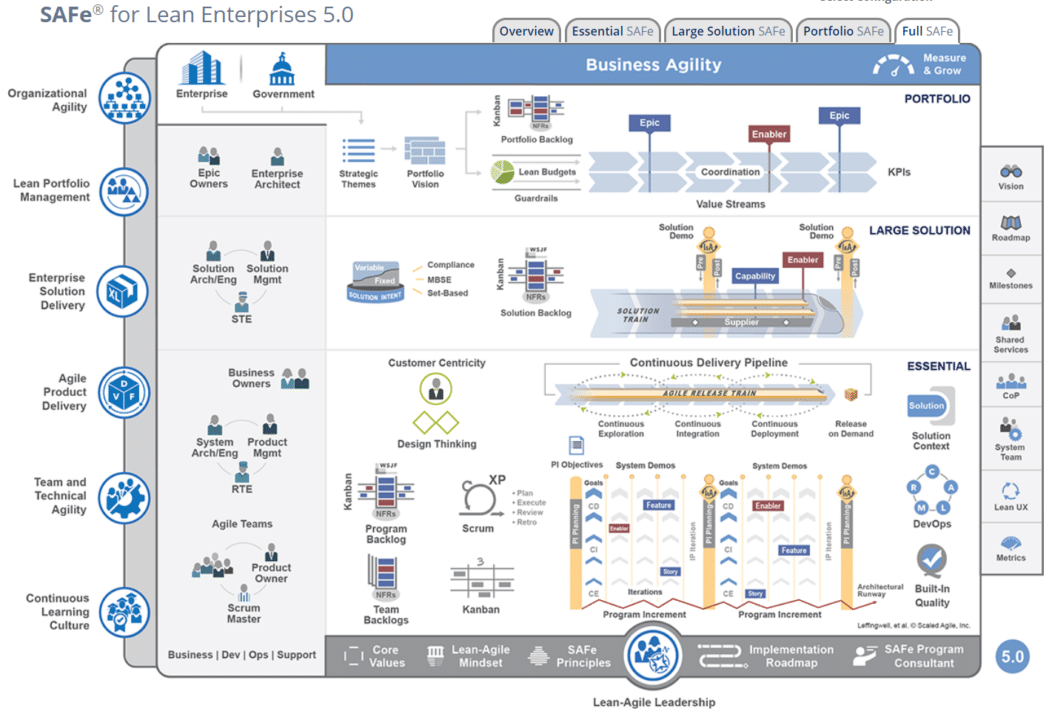
SAFe® for Lean Enterprises 5.0
SAFe does not change the thinking in the organisation, in fact, it solidifies rigidity by saying “this is how you do agile”. Thats the very antithesis of the intent behind the agile movement. You cant take someone else’s framework that worked in their organisation, like SAFe or Spotify, and install it in your organisation. You end up with fake agile, false security that you are embracing change while enshrining in the bureaucracy of the “way that we do things here”.
Scaled Agile Framework is just replacing one bureaucracy with another. Meet the new boss, same as the old boss.
Smart Classifications
Each classification [Concepts, Categories, & Tags] was assigned using AI-powered semantic analysis and scored across relevance, depth, and alignment. Final decisions? Still human. Always traceable. Hover to see how it applies.
What to read next
The Race for Market Responsiveness: A Fresh Perspective on Organisational Agility
Explores why true organisational agility means building custom processes to respond quickly to market changes, not just adopting popular …
Companies often say "we-are going Agile!" as if declaring it makes it so
Many companies mistake adopting Agile frameworks for true agility, but real success comes from customising ways of working to respond …
No successful company thrives by copying others’ ways of working
Successful companies thrive by creating unique ways of working, not by copying frameworks. Tailor your approach to fit your organisation’s …
Beyond the Agile Illusion: Embracing True Agility in a World of Taylorism
Explores the difference between true agility and superficial agile practices, highlighting the impact of Taylorism and offering steps to …
Scaling Smart: How to Build Sustainable Growth Without the Chaos
Learn how to achieve sustainable, resilient organisational growth by focusing on simplification, value delivery, and effective agile …
Evolution not Transformation: This is the Inevitability of change
Change in organisations is a continuous, evolutionary process driven by experimentation and adaptation, not a one-time transformation or …
Detecting agile theatre with real delivery signals
Why Most Companies Operating Models Fail in Dynamic Markets
A concise comparison of Predictive and Adaptive Operating Models, explaining why traditional structures fail in dynamic markets and how …
Don’t Manage Dependencies, Remove Them
Explains why dependencies are a sign of poor system design and outlines steps to eliminate them by aligning teams, clarifying ownership, and …
The Estimation Trap: How Tracking Accuracy Undermines Trust, Flow, and Value in Software Delivery
Tracking estimation accuracy in software delivery leads to mistrust, fear, and distorted behaviours. Focus on customer value, flow, and …
Flow of Value vs Flow of Work – Misnomer or Useful Shorthand?
Compares “flow of value” and “flow of work” in Kanban, explaining why only validated outcomes count as value and stressing the need for …
Why Outsourcing DevOps Fails, and How Real Engineering Excellence Starts With Your Team
Avoid DevOps vendor lock-in, discover how true engineering excellence starts with partnership, not outsourcing. Ready to transform your …
Why Most Companies Operating Models Fail in Dynamic Markets
A concise comparison of Predictive and Adaptive Operating Models, explaining why traditional structures fail in dynamic markets and how …
Don’t Manage Dependencies, Remove Them
Explains why dependencies are a sign of poor system design and outlines steps to eliminate them by aligning teams, clarifying ownership, and …
The Estimation Trap: How Tracking Accuracy Undermines Trust, Flow, and Value in Software Delivery
Tracking estimation accuracy in software delivery leads to mistrust, fear, and distorted behaviours. Focus on customer value, flow, and …
Kendall Guide - A System of Work for AI Adoption
Flow of Value vs Flow of Work – Misnomer or Useful Shorthand?
Compares “flow of value” and “flow of work” in Kanban, explaining why only validated outcomes count as value and stressing the need for …
Estimating Better in an Overloaded System Is a Poor Man’s Strategy
High work in progress (WIP) causes delays and unpredictability; improving estimates won’t help. Limiting WIP and focusing on flow is key to …