As more and more organisations move towards a higher degree of agility, they inevitably also move towards DevOps practices like Continuous Delivery to facilitate shortening the feedback loops.
Firms today experience a much higher velocity of business change. Market opportunities appear or dissolve in months or weeks instead of years.
Diego Lo Giudice and Dave West, Forrester
February 2011
Transforming Application Delivery
Shortening the feedback loop is imperative to remaining competitive in this new world of customer-centric realities and that in turn requires a radical shift in practices. This shift towards getting things in front of your customers as quickly as possible to find out if you are even doing the right thing means that we are no longer deploying our products every 2 years. We are doing it every day. Microsoft, for example, has gone from one or two major releases a year to over a hundred-sixty-thousand deployment a day. Thats more than the number of engineers that they have. The same practices that worked before will not work today. We need to be faster, better, and more secure than ever before. Everything must be done within the sprint loop and all responsibility needs to lie with those doing the work.
“In the long history of humankind (and animal-kind, too) those who learned to collaborate and improvise most effectively have prevailed. ”
-Charles Darwin
In order to sustain this new way we must be able to maintian the resonsabilities of high quality with the operational needs of the busienss while continiously delivering awesome features that delight our customers.
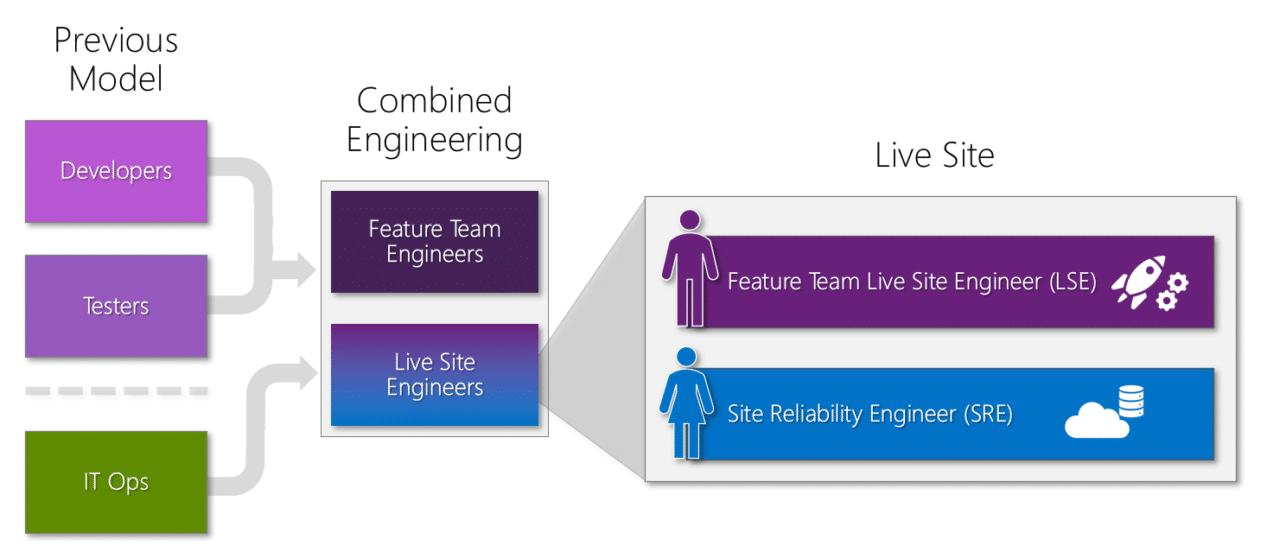
Combined Engineering Model of the Azure DevOps Product Team at Microsoft
The Combined Engineering model adopted by the Azure DevOps Product Team at Microsoft is an example of how one group of about 650 engineers in 3 main locations around the world has evolved to be able to cope with these new realities.
The following presentation represents mearly a point in time of their evolution that may serve to give you some ideas of where to start, and maybe an intial goal to achieve. This infortmation reflects this teams structure and thought in 2018 and they have continued to evolve since this content was created.
Presentation: https://nkdagility.net/3edOLPi
Smart Classifications
Each classification [Concepts, Categories, & Tags] was assigned using AI-powered semantic analysis and scored across relevance, depth, and alignment. Final decisions? Still human. Always traceable. Hover to see how it applies.
What to read next
Transforming Agility: How Azure DevOps Went from Two-Year Releases to 880,000 Deployments
Explores how Azure DevOps shifted from slow, two-year releases to rapid, continuous delivery, highlighting the benefits of fast feedback, …
From Chaos to Clarity: My Journey Through DevOps and the Three Key Challenges to Overcome
Explores a developer’s transition to DevOps, highlighting key challenges: cultural change, toolchain automation, and continuous learning for …
Stop Hiding Behind Complexity and Start Delivering Continuously
Continuous delivery is achievable for any software, regardless of complexity. Success depends on investment in automation, quality, and …
Mastering Site Reliability: Insights from Azure DevOps on Building a Resilient Live Site Culture
Explore proven strategies from Azure DevOps for building resilient, reliable software systems, covering transparency, automation, telemetry, …
The Common Challenges of Adopting DevOps Practices
Explores key challenges in adopting DevOps, including managing evolving risks and closing feedback loops, with strategies for rapid …
Rethinking Continuous Delivery: Why Best Practices Don't Exist in Complex Environments
Explores why fixed best practices don't suit complex continuous delivery, highlighting adaptive approaches like audience-based delivery, …
Detecting agile theatre with real delivery signals
Why Most Companies Operating Models Fail in Dynamic Markets
A concise comparison of Predictive and Adaptive Operating Models, explaining why traditional structures fail in dynamic markets and how …
Don’t Manage Dependencies, Remove Them
Explains why dependencies are a sign of poor system design and outlines steps to eliminate them by aligning teams, clarifying ownership, and …
The Estimation Trap: How Tracking Accuracy Undermines Trust, Flow, and Value in Software Delivery
Tracking estimation accuracy in software delivery leads to mistrust, fear, and distorted behaviours. Focus on customer value, flow, and …
Flow of Value vs Flow of Work – Misnomer or Useful Shorthand?
Compares “flow of value” and “flow of work” in Kanban, explaining why only validated outcomes count as value and stressing the need for …
Why Outsourcing DevOps Fails, and How Real Engineering Excellence Starts With Your Team
Avoid DevOps vendor lock-in, discover how true engineering excellence starts with partnership, not outsourcing. Ready to transform your …
Detecting agile theatre with real delivery signals
Don’t Manage Dependencies, Remove Them
Explains why dependencies are a sign of poor system design and outlines steps to eliminate them by aligning teams, clarifying ownership, and …
The Estimation Trap: How Tracking Accuracy Undermines Trust, Flow, and Value in Software Delivery
Tracking estimation accuracy in software delivery leads to mistrust, fear, and distorted behaviours. Focus on customer value, flow, and …
Flow of Value vs Flow of Work – Misnomer or Useful Shorthand?
Compares “flow of value” and “flow of work” in Kanban, explaining why only validated outcomes count as value and stressing the need for …
Why Outsourcing DevOps Fails, and How Real Engineering Excellence Starts With Your Team
Avoid DevOps vendor lock-in, discover how true engineering excellence starts with partnership, not outsourcing. Ready to transform your …
Estimating Better in an Overloaded System Is a Poor Man’s Strategy
High work in progress (WIP) causes delays and unpredictability; improving estimates won’t help. Limiting WIP and focusing on flow is key to …
Why Outsourcing DevOps Fails, and How Real Engineering Excellence Starts With Your Team
Avoid DevOps vendor lock-in, discover how true engineering excellence starts with partnership, not outsourcing. Ready to transform your …
Why Big Bang Rewrites Fail: How Sustainable Change and Engineering Excellence Transform Legacy Systems
Ditch the Big Bang rewrite. Discover why sustainable, in-place change drives true engineering excellence and lasting transformation in your …
Are We Still Pretending Coding Was the Bottleneck?
AI exposes that coding was never the main bottleneck in software delivery; real constraints are in system flow, team practices, and …
Why Azure DevOps Wins for Governance, Security, and Scale, Right Out of the Box
Unlock seamless governance, security, and scale with Azure DevOps, integrated tooling that lets you deliver value, not just manage …
Should You Use One Project to Rule Them All in Azure DevOps?
Explores when to use a single Azure DevOps project versus multiple projects, detailing impacts on flow, visibility, governance, and team …
Stop Guessing: How to Make Work Visible and Drive Real Improvement with Azure DevOps Flow Metrics
Stop guessing, start making data-driven decisions in Azure DevOps. Discover tools, tips, and insights to make your work visible and your …
Why Most Companies Operating Models Fail in Dynamic Markets
A concise comparison of Predictive and Adaptive Operating Models, explaining why traditional structures fail in dynamic markets and how …
Don’t Manage Dependencies, Remove Them
Explains why dependencies are a sign of poor system design and outlines steps to eliminate them by aligning teams, clarifying ownership, and …
The Estimation Trap: How Tracking Accuracy Undermines Trust, Flow, and Value in Software Delivery
Tracking estimation accuracy in software delivery leads to mistrust, fear, and distorted behaviours. Focus on customer value, flow, and …
Kendall Guide - A System of Work for AI Adoption
Flow of Value vs Flow of Work – Misnomer or Useful Shorthand?
Compares “flow of value” and “flow of work” in Kanban, explaining why only validated outcomes count as value and stressing the need for …
Estimating Better in an Overloaded System Is a Poor Man’s Strategy
High work in progress (WIP) causes delays and unpredictability; improving estimates won’t help. Limiting WIP and focusing on flow is key to …