 Over the last week I have been looking at the source for the Family.Show application from Vertigo . I needed to look at methods of presentation of hierarchical information graphically using WPF and I saw this as a good representation of that sort of data. So I se about not only converting it to VB.NET but adding generics to the mix.
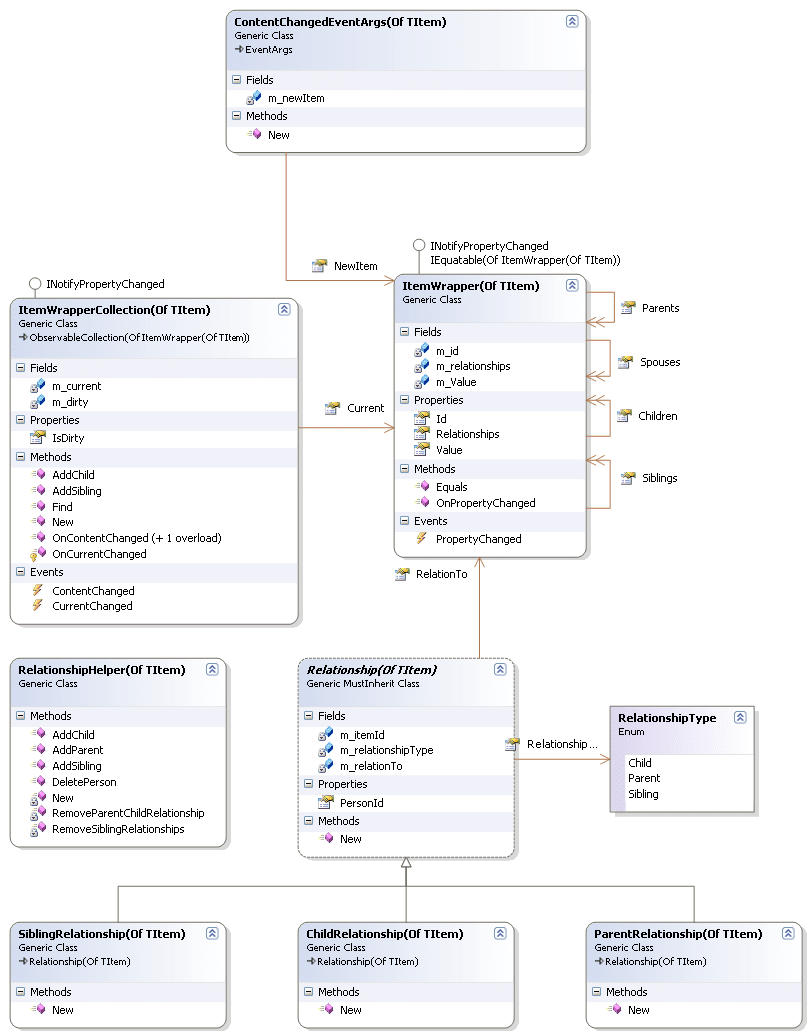
The first part of the application is the core objects that represent the data and allow interaction in a way that WPF can handle. This means using Observable Collections and implementing INotifyPropertyChanged to allow a higher level of interaction. I wanted to support any Source object type as well as my own custom types, so the type needed to be nested with a Wrapper that gives the illusion that it is a solid type, but in actual fact it is a soft wrapper that allows the system to interact with it without really understanding the type. The specific understanding of the type is done at a much higher level.
You will need to open this diagram in a new window to get the effect, but it is a completely generic representation of Parent, Child and Sibling relationships for any object regardless of wither you have access to the source or not.
This is not currently designed to be an editable object, but inheriting from the ItemWrapper class would allow this, but would require a modification to the framework to handle the inherited type. Maybe v2…
Technorati Tags: .NET WPF Design WIT Developing
What to read next
TFS Sticky Buddy layout fun
A developer shares challenges and insights from building a TFS Sticky Buddy UI in WinForms and WPF, comparing layout issues and ease of use …
TFS Sticky Buddy 2.0 development started…
Development of TFS Sticky Buddy 2.0 has begun, focusing on modular WPF architecture and new navigation features. Early CTP version and …
Detecting agile theatre with real delivery signals
Why Most Companies Operating Models Fail in Dynamic Markets
A concise comparison of Predictive and Adaptive Operating Models, explaining why traditional structures fail in dynamic markets and how …
Don’t Manage Dependencies, Remove Them
Explains why dependencies are a sign of poor system design and outlines steps to eliminate them by aligning teams, clarifying ownership, and …
The Estimation Trap: How Tracking Accuracy Undermines Trust, Flow, and Value in Software Delivery
Tracking estimation accuracy in software delivery leads to mistrust, fear, and distorted behaviours. Focus on customer value, flow, and …
Flow of Value vs Flow of Work – Misnomer or Useful Shorthand?
Compares “flow of value” and “flow of work” in Kanban, explaining why only validated outcomes count as value and stressing the need for …
Why Outsourcing DevOps Fails, and How Real Engineering Excellence Starts With Your Team
Avoid DevOps vendor lock-in, discover how true engineering excellence starts with partnership, not outsourcing. Ready to transform your …
Detecting agile theatre with real delivery signals
Don’t Manage Dependencies, Remove Them
Explains why dependencies are a sign of poor system design and outlines steps to eliminate them by aligning teams, clarifying ownership, and …
The Estimation Trap: How Tracking Accuracy Undermines Trust, Flow, and Value in Software Delivery
Tracking estimation accuracy in software delivery leads to mistrust, fear, and distorted behaviours. Focus on customer value, flow, and …
Flow of Value vs Flow of Work – Misnomer or Useful Shorthand?
Compares “flow of value” and “flow of work” in Kanban, explaining why only validated outcomes count as value and stressing the need for …
Why Outsourcing DevOps Fails, and How Real Engineering Excellence Starts With Your Team
Avoid DevOps vendor lock-in, discover how true engineering excellence starts with partnership, not outsourcing. Ready to transform your …
Estimating Better in an Overloaded System Is a Poor Man’s Strategy
High work in progress (WIP) causes delays and unpredictability; improving estimates won’t help. Limiting WIP and focusing on flow is key to …