 There has been a subtle but targeted change in the wording used as part of Scrum. There has bee a move away from commitment towards forecasting what will be completed. Why is this happening and what does it mean to my team?
There has long been a subtle lack of transparency between the Product Owner and the Development Team that has largely gone unnoticed. In the empirical world that is Software Development it is not possible to commit to delivering anything! This is reminiscence of the institutional fiction that we can indeed give someone a guaranteed delivery date for something that exists in the complex world and thus is impossible for us to estimate. We have been doing it for years and we are still doing it even in Agile. The only saving grace is that our commitment has been for such a small amount of work that we are routinely forgiven and indeed any good Product Owner quickly learns that Commitment is really a guess and can often be a WAG (Wild Assed Guess) at best.
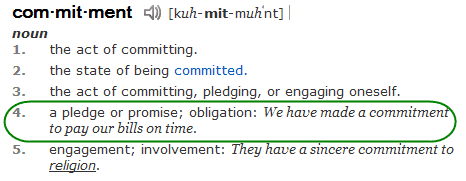
Figure: The meaning of commitment
Where are these points in Scrum where commitment has been applied:
- Daily Scrum During the daily Scrum the Development Team get together to review each others previous days commitment and then commit to each other to completing work.
- Sprint Planning During Sprint Planning the Development Team commit to delivering work to the Product Owner at the end of the Sprint.
There are also a number of other commitment points that are implied in Scrum. The Product Owner is probably committing to delivering functionality to the Stakeholders (The Business) and often the Business will then commit to delivering functionality to their Customer.
And this is where the major problem lies as there are escalating cycles of impact at all levels.
- An Individual fails in their commitment to the Development Team
- A Development Team fails in its commitment to the Product Owner
- A Product Owner fails in their commitment to the Business
- The Business fails in its commitment to its Customers
If you have “commitment” then others will read that as something that can be relied on and potentiality take a dependency on the timely completion of that work. Once a dependency is taken then it can be a BIG problem if things go south. What if your Sales teams have made commitments to old customers to get them to say and to new customers to get them to change to you?
This is the result of committing to delivering work, so I say again:
Can you really commit to delivering work?
The word “Commitment” smacks too much of the Prescriptive world and not enough of the Predictive. Can we stop diluting a perfectly prescriptive word? Is there a better choice that lives in the Predictive world?

Figure: Would you hold a weather presenter to a 10 day forecast?
The new Scrum Guide talks about Forecast instead of the Commitment. This is a subtle and carefully chosen contrast that is intended to result in a more positive open and transparent communication between the key actors in the pantomime that has been Software Development.
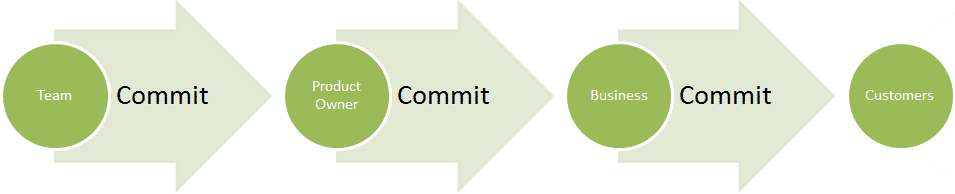
 Figure: Bad example, “Commitment” implies that we know for sure
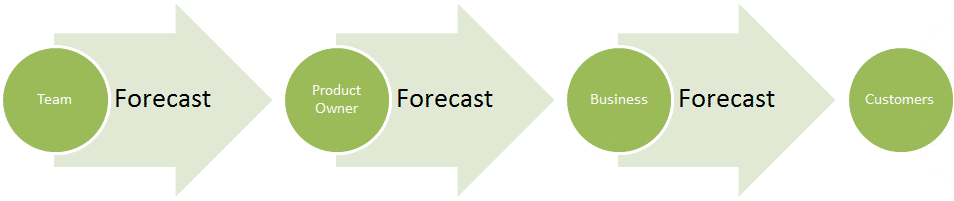
 Figure: Good example, “Forecast” implies that we don’t know for sure
The result should be higher levels of trust between all parties that should result in less (or at least more well known and specific) dependencies that are of much lower risk. If we make that change we really start thinking in the Agile / Predictive space and some of the old ways will drop by the wayside. Those old ways are the things that get in the way of an Agile adoption, that make us want to drop back into our old comfortable bad habits of Waterfall.
Are you going to make the change from Commitment to Forecast?
If not, let me know why this will not make sense in your organisation!
Smart Classifications
Each classification [Concepts, Categories, & Tags] was assigned using AI-powered semantic analysis and scored across relevance, depth, and alignment. Final decisions? Still human. Always traceable. Hover to see how it applies.
What to read next
How do you make a good Forecast?
Explains how to create reliable forecasts in agile projects by using flow metrics like cycle time and throughput, and shifting from …
Rethinking Software Estimation: Embrace Probabilistic Forecasting for Agile Success
Explores how probabilistic forecasting improves software project planning by replacing traditional estimation with data-driven confidence …
Release planning and predictable delivery
Explores how agile teams can achieve predictable software delivery through quality focus, effective release planning, and continuous …
Unlocking Agile Success: Embrace Continuous Forecasting and Transform Your Training Experience
Explore practical strategies for Agile training, including virtual class setups, continuous forecasting, and using metrics to improve …
Are you doing Scrum? Really?
Explains recent changes to Scrum aimed at reducing rigidity, clarifying core practices, and providing a checklist to help teams assess if …
Story Points & Velocity are a sign of an unsuccessful team
Explains why relying on story points and velocity signals team immaturity in Scrum, and highlights better ways to build confidence and …
Detecting agile theatre with real delivery signals
Why Most Companies Operating Models Fail in Dynamic Markets
A concise comparison of Predictive and Adaptive Operating Models, explaining why traditional structures fail in dynamic markets and how …
Don’t Manage Dependencies, Remove Them
Explains why dependencies are a sign of poor system design and outlines steps to eliminate them by aligning teams, clarifying ownership, and …
The Estimation Trap: How Tracking Accuracy Undermines Trust, Flow, and Value in Software Delivery
Tracking estimation accuracy in software delivery leads to mistrust, fear, and distorted behaviours. Focus on customer value, flow, and …
Flow of Value vs Flow of Work – Misnomer or Useful Shorthand?
Compares “flow of value” and “flow of work” in Kanban, explaining why only validated outcomes count as value and stressing the need for …
Why Outsourcing DevOps Fails, and How Real Engineering Excellence Starts With Your Team
Avoid DevOps vendor lock-in, discover how true engineering excellence starts with partnership, not outsourcing. Ready to transform your …
The Definition of Done is a Commitment to Quality
Defines the Definition of Done in Scrum as a clear, shared standard for quality, ensuring increments are releasable, transparent, and …
Why Your Definition of “Done” Is Holding Back Quality, Agility, and Trust, And How to Raise the Bar
Is your team’s “done” really done? Discover how a clear, objective definition of done boosts quality, agility, and trust in product …
Acceptance Criteria vs Definition of Done: Why Getting This Right Builds Trust and Delivers Quality Faster
Stop confusing acceptance criteria with definition of done, learn the crucial difference to boost quality, speed, and trust in your agile …
How to Evolve Your Definition of Done: Start Small, Grow Smarter, and Build Lasting Momentum
Unlock a smarter Definition of Done, start small, evolve standards, and build team momentum without overwhelm. Discover how progress drives …
Why Most Transformations Fail Without Honest Conversations
Most transformations fail without open, honest conversations that address real issues, making transparency and tough dialogue essential for …
Why Your Definition of Done Is the Secret Weapon for Real Business Impact and Agile Growth
Transform your definition of done into a strategic advantage, deliver real value, reduce risk, and drive business impact with every sprint.